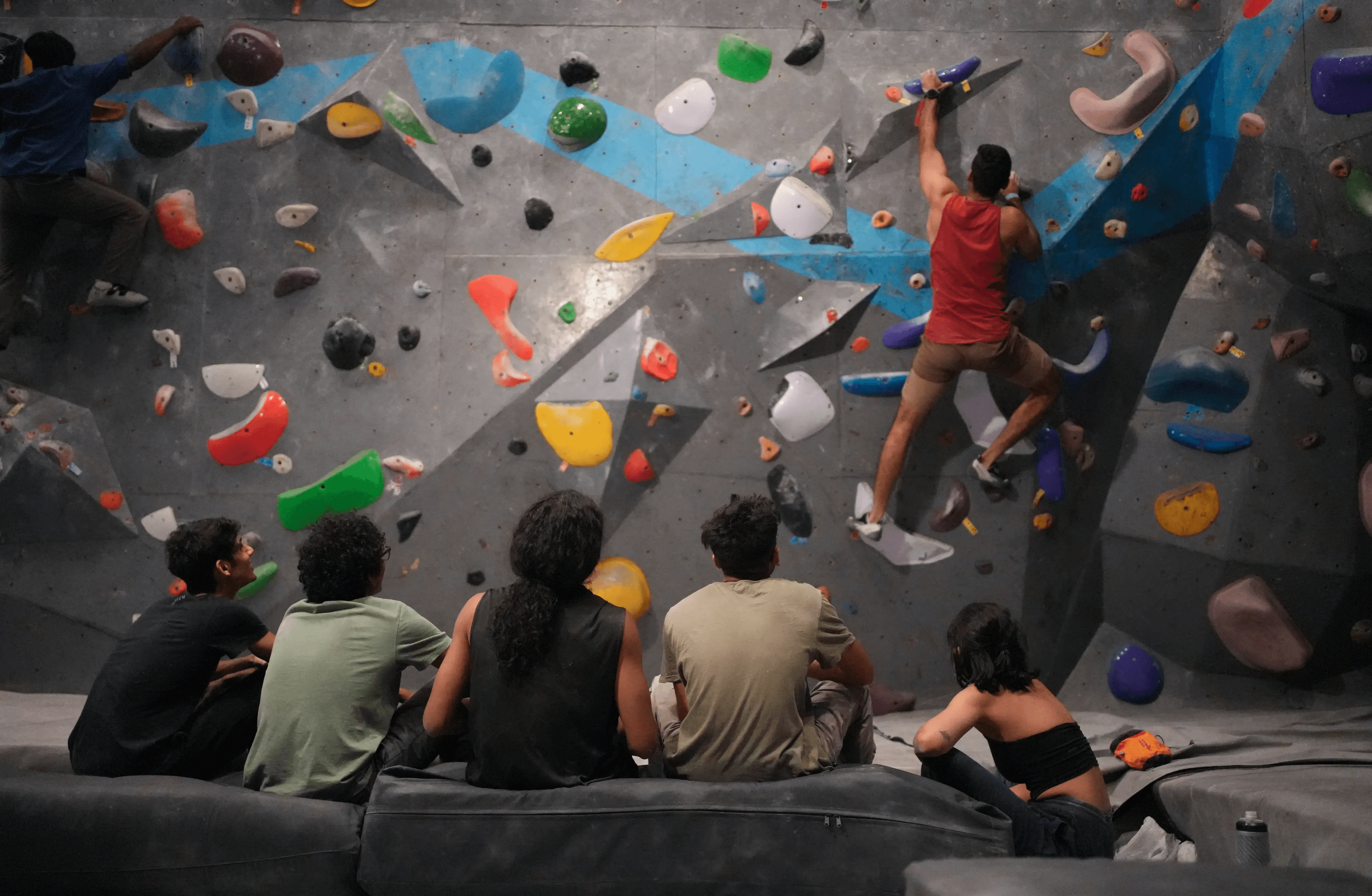








📺 Boulderly

Rock climbing is an activity that is rapidly growing in popularity worldwide, however, there is a lack of information regarding the navigation to and identification of outdoor boulder problems in India. We developed a free-to-use mobile application to enhance accessibility to outdoor climbing in Sethan, India.

Type

Design for Society (Lean Project)

Timeline

September 2025 - Present

Role

UX/UI Designer & Front-End Developer

This project was executed in collaboration with Rahul Peter.

Initial Brief

To enhance the accessibility of outdoor boulder problems in India by aiding in navigation.

Lean Project Methodology

Through the experience of building my startup, Alphaherd, the importance of a lean approach to building was ingrained into me. Thus, to create maximum output with strategic input, Rahul and I decided to follow this lean project methodology.

  • We systematically eliminated unnecessary steps, resources and time.

  • We met in person and worked in sprints any chance we found free time.

  • We identified user requirements early-on reducing length of iteration cycles.

  • We solved for just the core problem, eliminating any bells and whistles.

  • We made sure to solve this core problem extremely well.

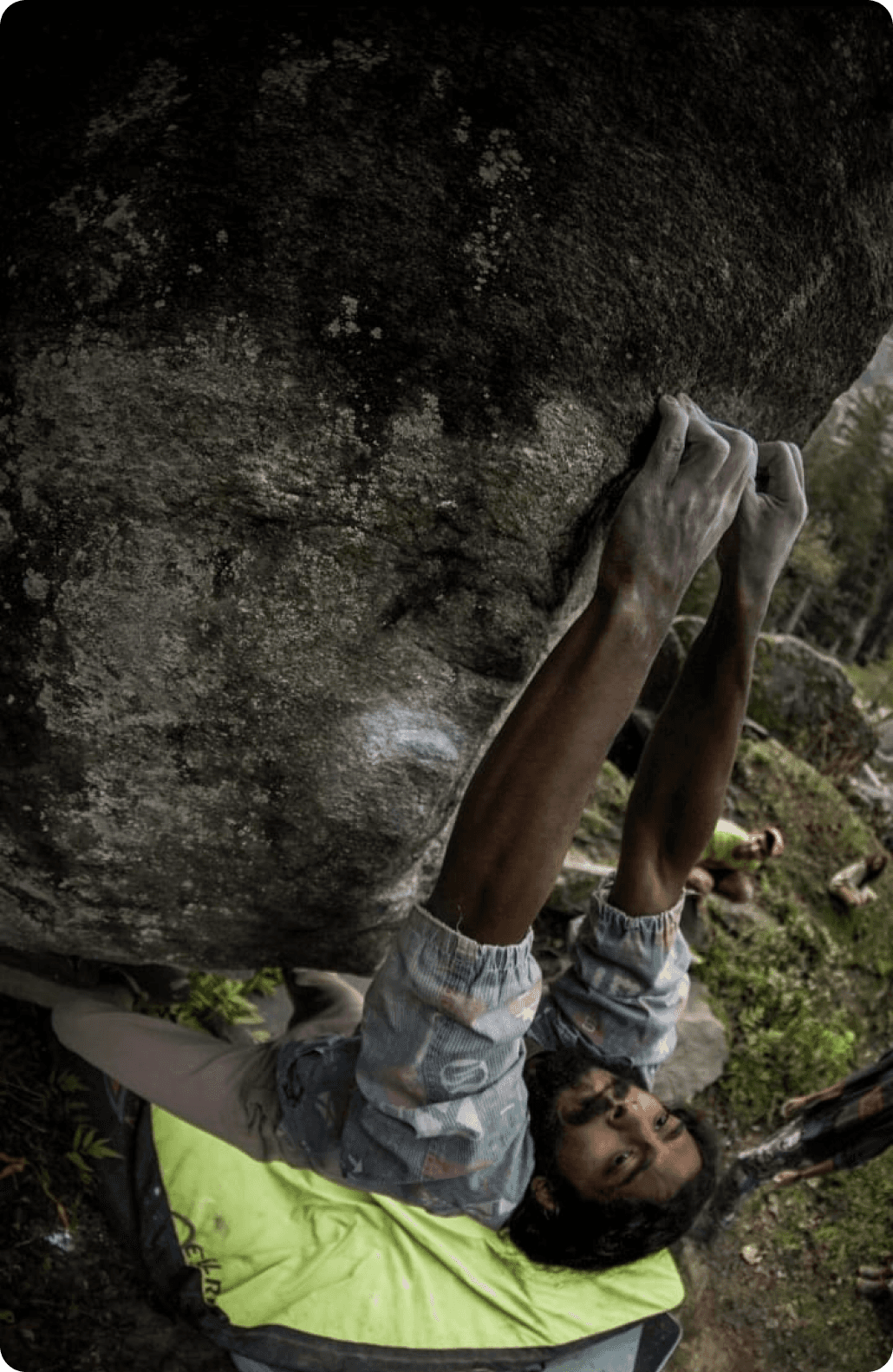
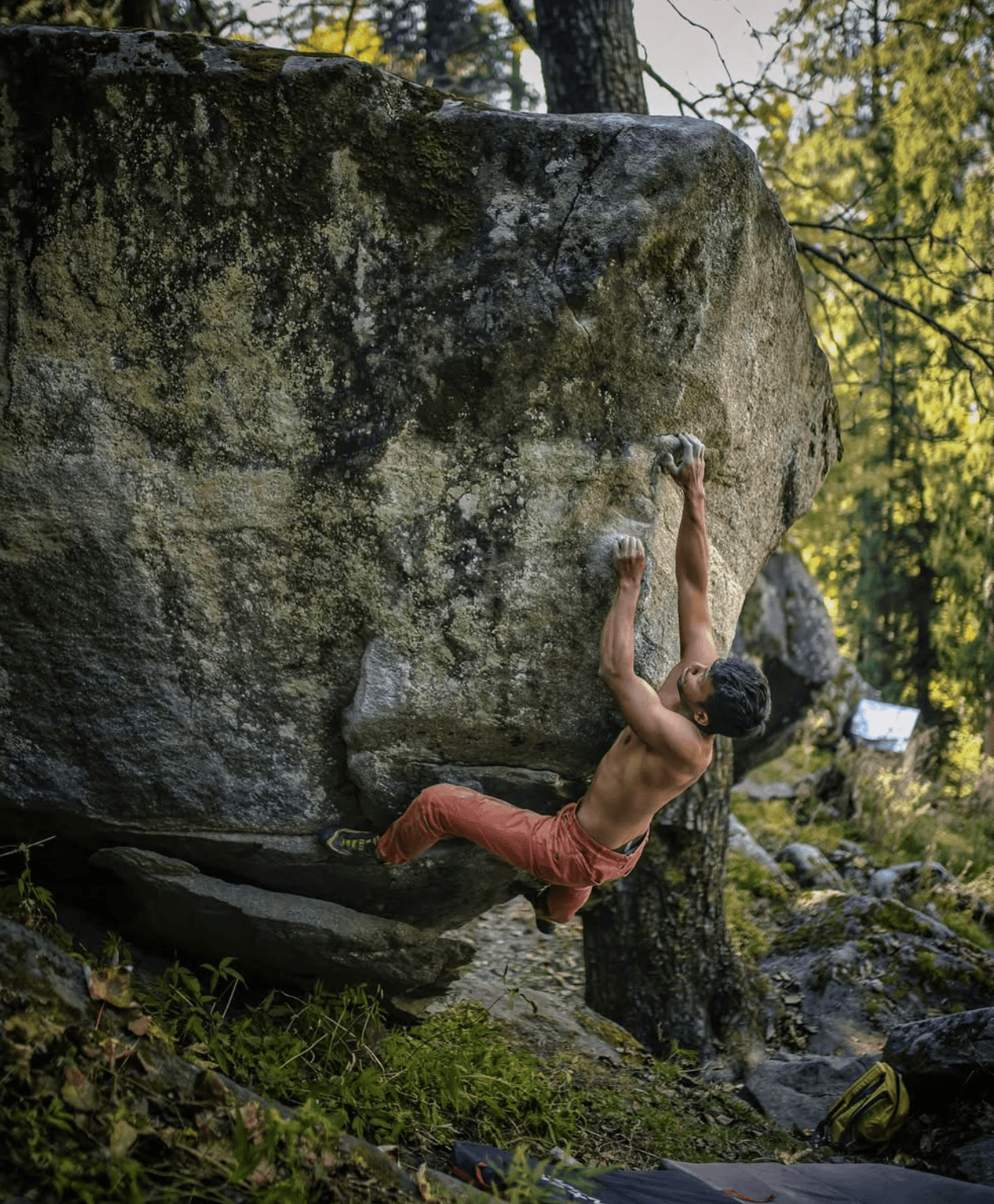
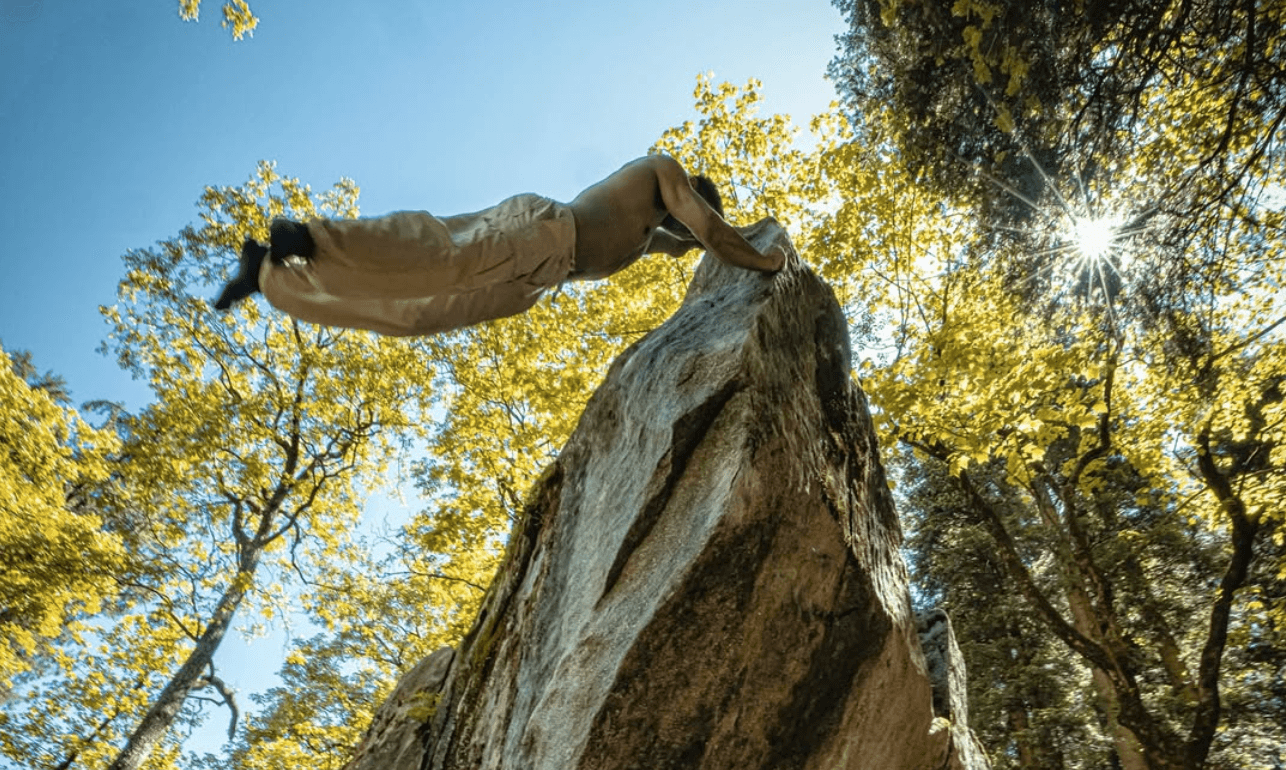
Jagdish Jangir climbing a boulder in Sethan (Image Credit: Abhijeet Sing)

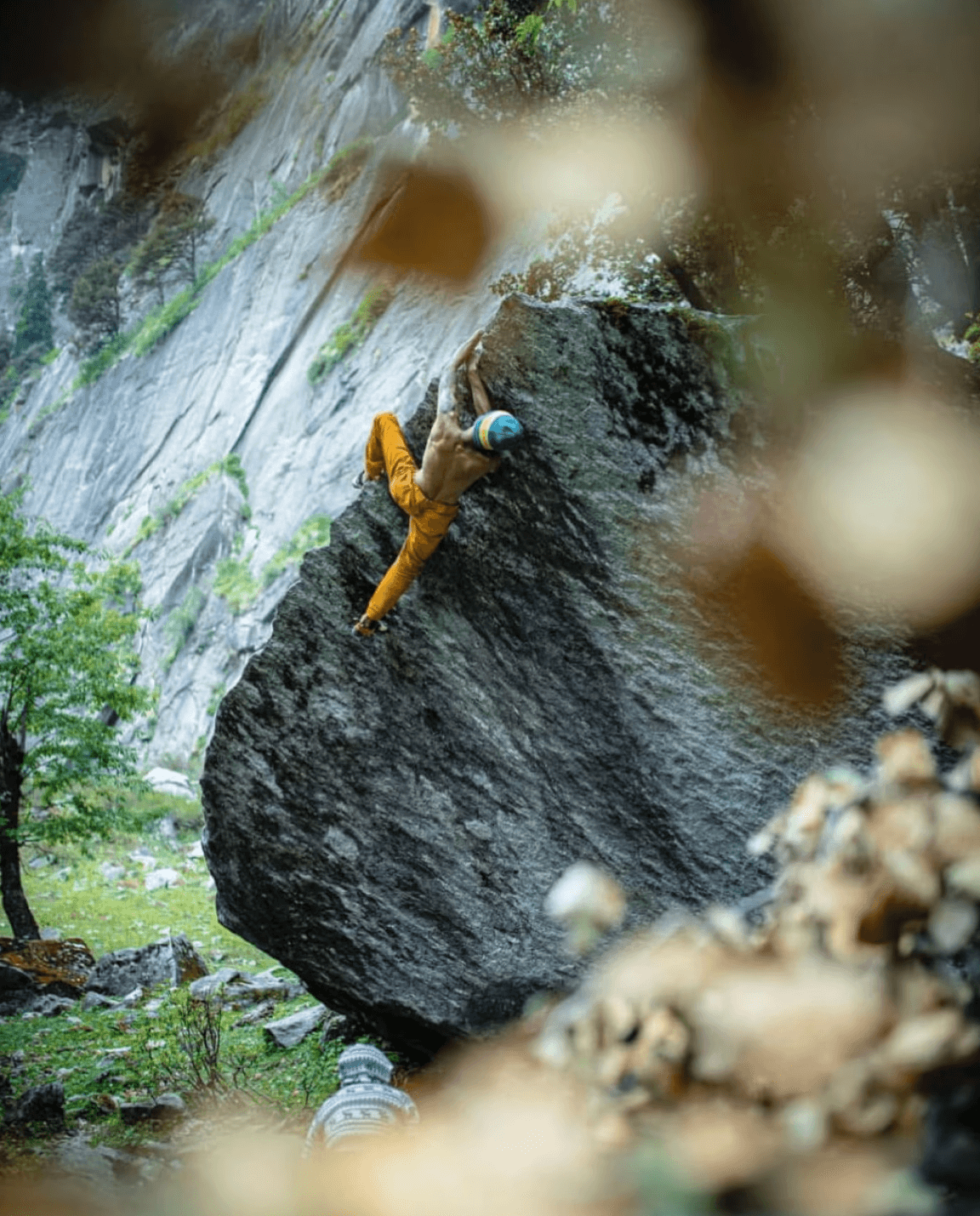
Rishi Vairale climbing a boulder in Sethan (Image Credit: Abhijeet Sing)

Project Context - What are we solving?

Rahul and I are an active part of the bouldering and rock climbing community in India. As intermediate climbers, we've spent a lot of time bouldering in indoor gyms, and were curious to make our outdoor debut. This is when we faced the challenge of transitioning to outdoor bouldering due to the lack of accessible data and the remote nature of these locations. Combining our passion for building and bouldering, we created Boulderly as a passion project to give back to the society.

What is bouldering?

Bouldering is a sub-category of rock climbing, the practice of climbing large boulders, either for practice or as a sport in it’s own right. Bouldering is an activity that can be done outdoors on real rock or in indoor gyms in a simulated format.

How does outdoor bouldering work?

Climbers travel to remote locations with crash pads and related climbing equipment to climb specific boulders that are popularised in the community. It is an extremely community-driven and social activity, where we put our lives in the hands of our friends who spot us and make sure we fall on the crashpads.

What is a crag?

While the word 'crag' literally means cliffside, boulderers use is to reference an area with multiple boulders where climbing happens.

How is information stored and communicated presently?

Currently, boulder information is stored in outdated, half-baked guidebooks or shared person-to-person.

Who are we building for?

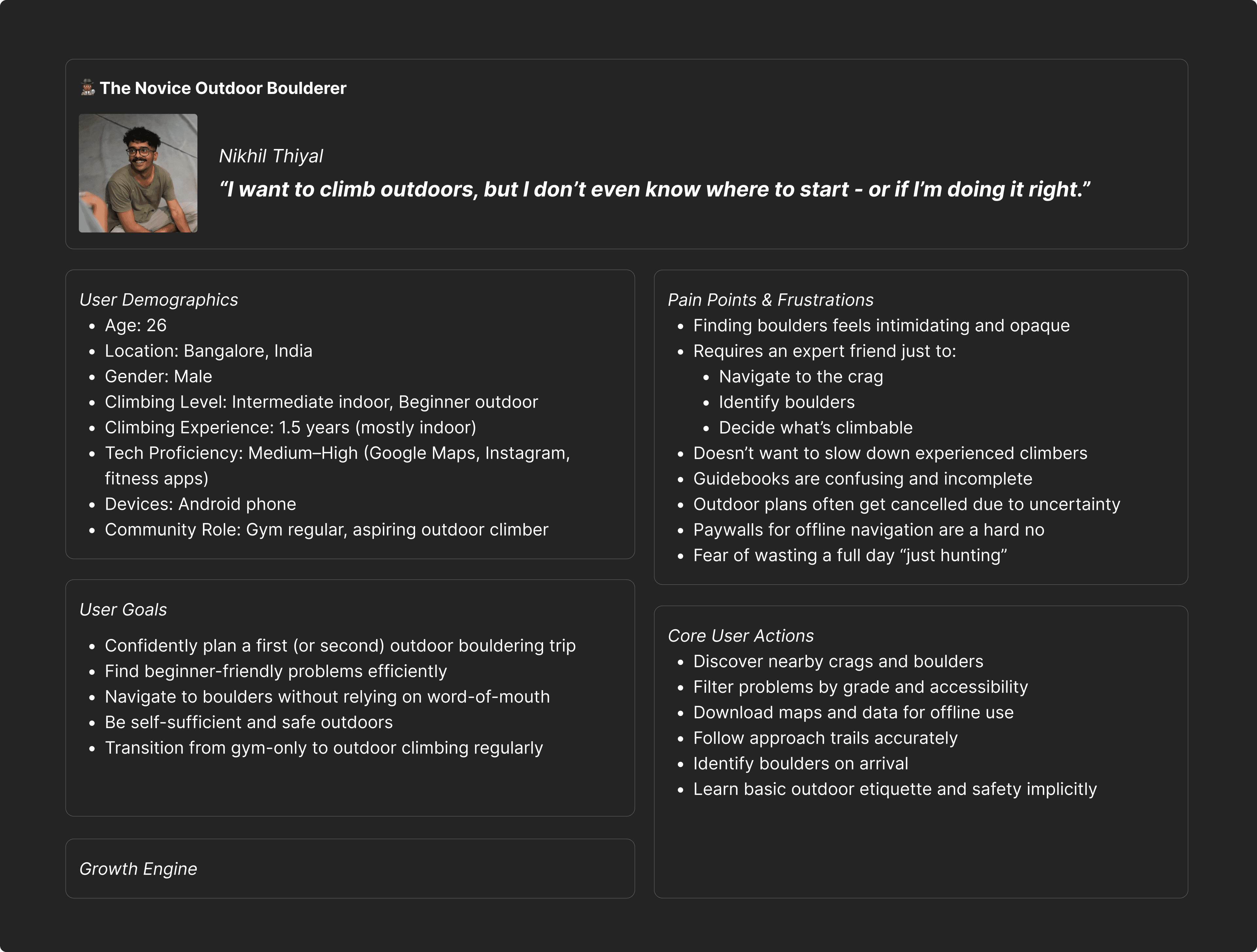
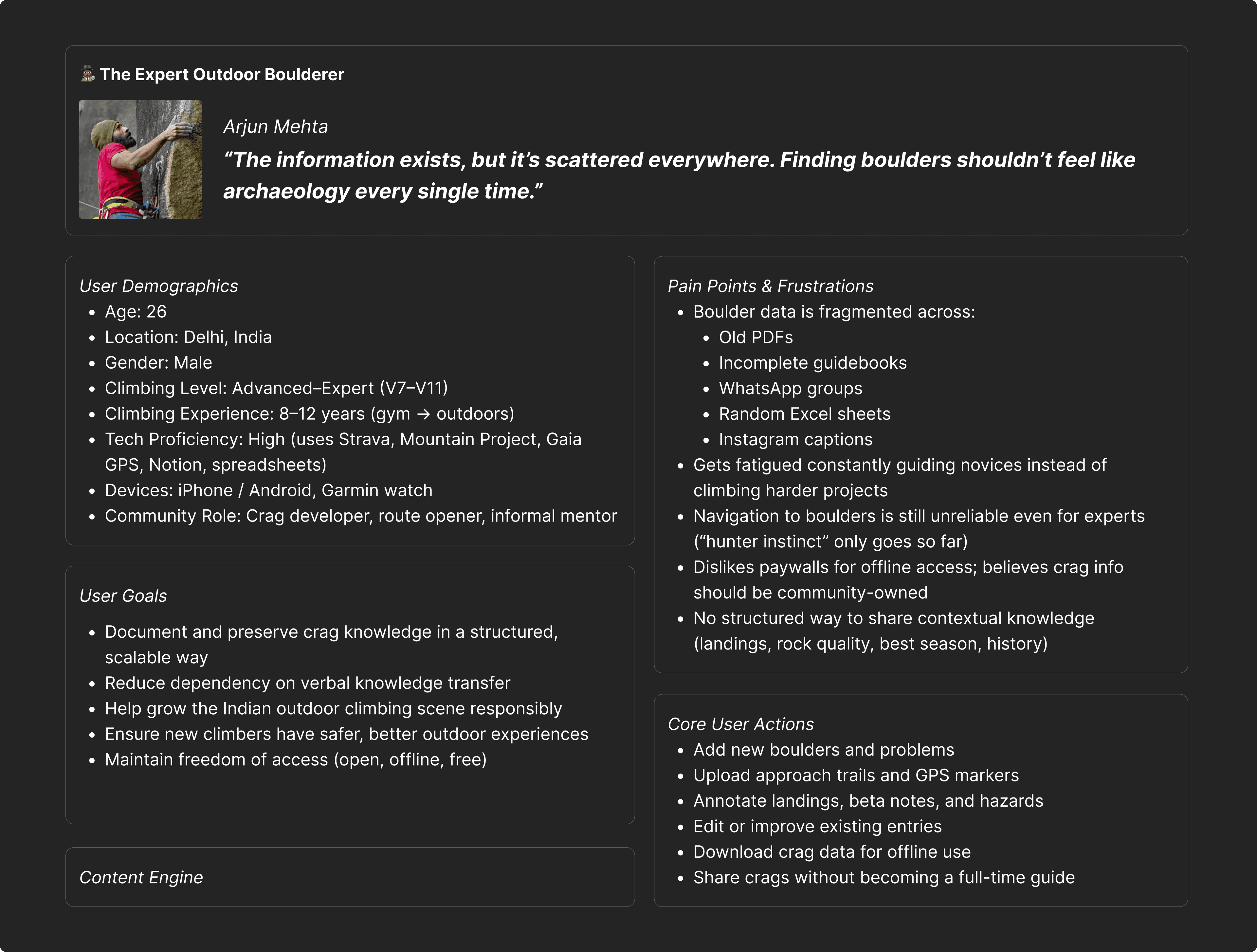
The Expert Boulderer: Experienced climbers who’ve involved in the development of boulders in a crag and hold undocumented boulder data. They are the facilitators who frequent the location and share the information with the community.

The 'Novice' Boulderer: Climbers who are just beginning to enter the outdoor climbing landscape, generally having intermediate experience climbing indoors. They are eager to to test their skills on real rock, but they have no idea how to find the boulders.

Bouldering in India

While bouldering has become the mainstream in geographies such as California, Japan, France and so on, it is still a relatively novel activity in India and has just begun gaining mass popularity. Most Indian boulderers confine themselves to the indoor gym despite expressing their interest to head outdoors, which is still a very niche practice and community across India.

Indoor Bouldering in India

The 1st commercial bouldering gym in India is just over a decade old now. While we can still count the number of Indian bouldering gyms on our fingertips, plans are in place for multiple new gyms to be set up in the coming years.

  • This is where a typical climber is introduced to the world of bouldering.

  • Boulderers begin their training here and learn about the world of outdoor climbing too.

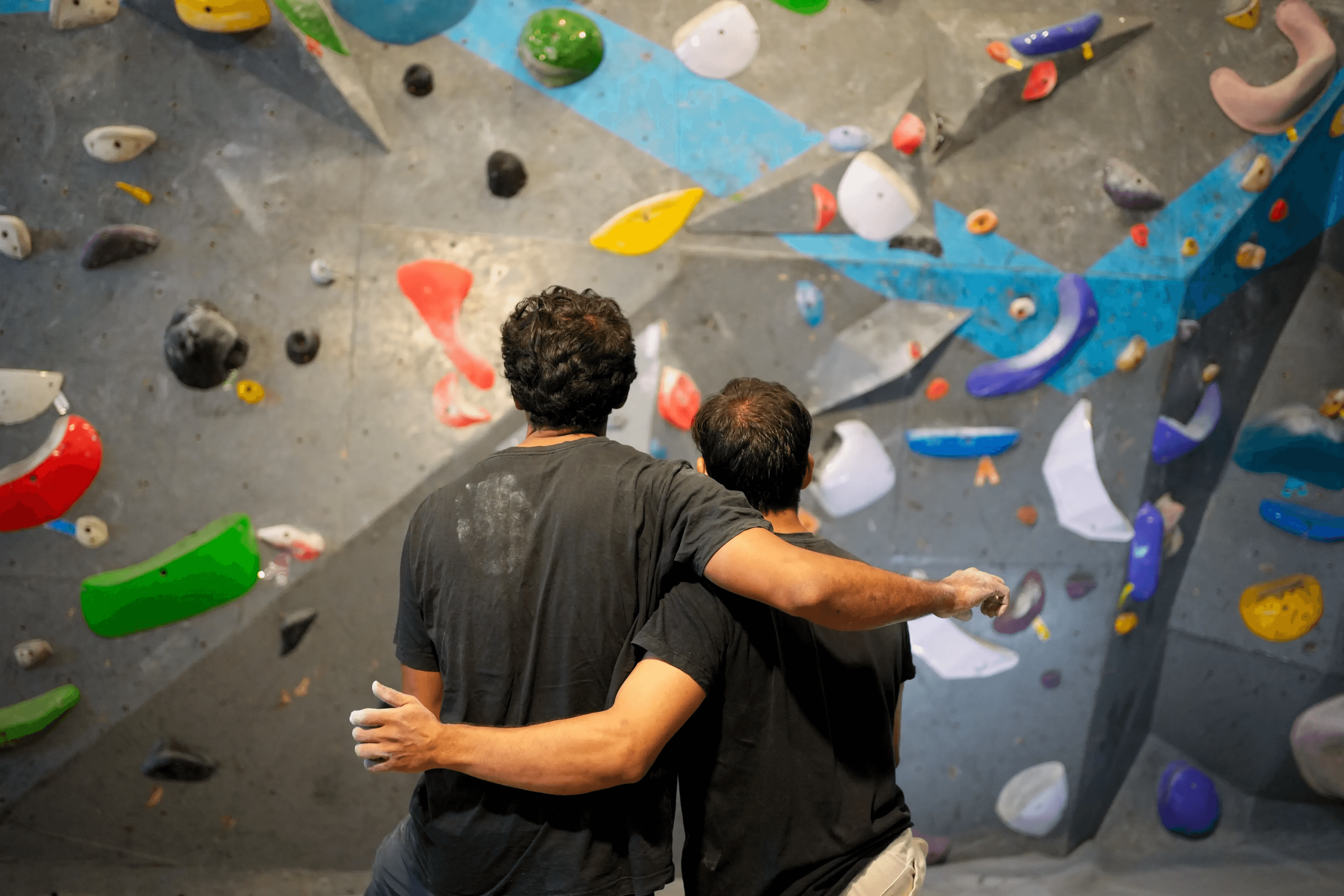
  • Boulderers make friends and become a part of the tight community.

  • There is no requirement for portable crashpads, as the gym has permanent pads in place.

  • Climbers can range from new climbers looking for a weekend activity, to the best climbers of the nation training for their competitions.

Outdoor Bouldering in India

While Hampi is a bouldering location that has attained worldwide popularity, it is an area that was developed in the 20th century by professional climbers from the USA. Besides this, most other crags have been developed in this century by Indian climbers, nevertheless, we are still scraping the surface of outdoor bouldering in India, with new discoveries surfacing rapidly.

  • Generally, when a climber reaches the intermediate stage, they want to proceed outdoors on real rock.

  • Popular boudering destinations in India include: Hampi, Sethan, Avathi, Raogudlu and many smaller crags.

  • A novice outdoor climber requires ties with experienced outdoor climbers to enter the scene.

  • This experience goes beyond climbing - trekking, bushwhacking, wildlife exploration, spotting (protecting fellow boulderers from ground falls).

Lean Competitor Analysis

I performed a competitor analysis of competitor and comparative platforms with the foll. objectives:

  • Familiarising myself with the competitive landscape

  • Obtaining actionable insights to direct the design

  • Identifying patterns to empathise with mental models of users

  • Identify a strong opportunity area - why don't these solutions work for our context?

27Crags

It is the only app with a high concentration of boulder data in Hampi, India, it's catering to certain international user groups. But, the navigation and certain details are hidden behind an expensive paywall rendering it useless for our user groups.

The Mountain Project

It is mainly used for documentation purposes of sport climbing routes and multi-pitch routes, there is a lack of any bouldering information.

Redpoint

Redpoint has solved the identification problem well using 3D scanned images of rocks. However, their focus is on sport climbing in developed areas and they have not solved for offline navigation.

All Trails

Adopted by boulderers who are also avid trekkers to create custom maps including coordinates of boulders. This is generally done as a personal repository, and aids specifically in navigation to the boulder.

Gaia GPS

The use case of Gaia GPS is the same as that of All Trails, boulderers add the coordinates of boulders onto their maps and access the data when required, this app is great for offline navigation.

Whatsapp Groups

Some crags have Whatsapp groups where a few new boulders and ascents are shared in an unorganised manner.

Instagram Profiles

Some climbers who are active in crag development post new boulders and ascents on their Instagram profile.

Youtube Profiles

Some climbers who are active in crag development post new boulders and ascents on their Youtube profile.

Where do the competitors fail?

There are 3 main problems with the existing solutions:

  • Offline navigation is hidden behind a paywall, Indian climbers believe that this information should be open source.

  • There is a lack of ability to navigate offline, this is a determining factor considering the remote location of these crags.

  • Existing information for outdoor boulders in India are stored in an extremely unorganised format.

Problem Validation + Interviews with 'Expert' and 'Novice' Outdoor Boulderers

Primary Research

We began by validating the initial brief, I simply conversed with climbers at my local climbing gym, both intermediate indoor climbers who have expressed the desire to climb outdoors as well as avid outdoor climbers. This process made it clear that this was not a personal problem but a problem faced by the community at large.

The 'Novice' Boulderer Outlook

I conducted 7 semi-structured interviews with intermediate indoor boulderers who want to head outdoors as novices:

  • 4 climbers who have never climbed real rock

  • 3 climbers who have climbed real rock just a few times

Objectives

  • To understand what stops indoor boulderers from taking the first step outdoors.

  • To understand problems faced while climbing outdoors.

  • To identify what information will help them navigate to boulders.

  • To identify what information will help them identify boulders.

  • Understand thoughts and concerns regarding the project.

Actionable Insights

  • Novice climbers currently require an in-person expert guide who is familiar with the crag to have a productive outdoor climbing experience.

  • It is next to impossible for novice climbers to find a boulder, it involves a lot of preperation, networking and 'hunting' to find them.

  • They are not willing to pay for offline boulder information access, competitors in developed areas follow this business model.

  • Novice climbers who are excited to go outdoors reduce their frequency or write off the idea as they can't fathom how to go about finding boulders.

  • They are interested in finding easier boulder problems, and don't want to waste the time of experienced climbers who want to tackle harder boulders.

  • Guidebooks are half-baked and aid in boulder identification but the location and navigation is still completely done through word of mouth.

  • Usage of other software requires a high level of preparation which generally doesn't happen in the excitement of heading out for the day.

  • 7/7 participants were skeptical about whether we could figure out offline navigation, but were excited by the prospect.

The 'Expert' Boulderer Outlook

We conducted 6 semi-structured interviews with expert boulderers who have either led crag development or have involved heavily in opening new routes.

  • 2 climbers who discovered major bouldering destinations in India.

  • 2 climbers who spend their life on the road, developing these destinations further.

  • 2 climbers who are leading the national climbing rankings.

Objectives

  • To understand how they store and communicate information.

  • Identify information that is considered important in the context of boulder data.

  • Learn about current navigation and boulder identification techniques and problems.

  • Understand thoughts and concerns regarding the project.

  • Identify the value they gain/bring beyond the core problem.

Actionable Insights

  • Expert climbers inevitably have ‘ownership disputes’ related to area development.

  • Expert climbers do find joy in showing around novice climbers, but they soon get tired of it and feel like it's an added responsibility.

  • They are not willing to pay for offline boulder information access, competitors in developed areas follow this business model.

  • They want to share information that converts a boulder from a ‘climb’ to an ‘experience’.

  • They still face issues navigating to certain boulders, although they proclaim themselves as better 'hunters'.

  • Currently, incomplete information is spread across unfinished guidebooks, random excel sheets, and social media platforms.

  • It's not possible to add boulder data from the crag itself, they have to go back and recall the information to input it into existing software.

  • 6/6 participants were excited by the idea and exhibited intent to aid in the addition of data.

User Personae

I gathered the data collected from prior research & coupled it with the desk research to craft user personas which guided decision-making in the design process.

Ideation & Development

Ideation Brief

To create a mobile application that allows novice and expert boulderers alike to find suitable boulders to climb and successfully navigate to and identify these boulders in Sethan, India, while empowering expert boulderers to share boulder data in an organised manner.

Why are we designing for Sethan, India?

Sethan village is a world-class bouldering destination in Himachal Pradesh, India, situated closeby to Manali, a popular tourist destination. Since this destination has been recently discovered and is barely developed, the problem of boulder navigation and identification is especially painful in this remote location; due to the vast area, high density of boulders and complete lack of internet in the wilderness.

We decided to develop Boulderly for the context of Sethan to narrow down our scope and solve the nucleated problems of targetted users in this environment.

How would this product translate to destinations beyond Sethan?

This app will prove valuable for crags in developing countries such as India, China and South Korea where the practice of bouldering is rapidly growing but the users believe that this information should be available free of cost (as opposed to to the belief system in already developed nations). In the long run, as we input and improve the quality of data and offerings on Boulderly, we can consider undercutting the established, expensive competitors.

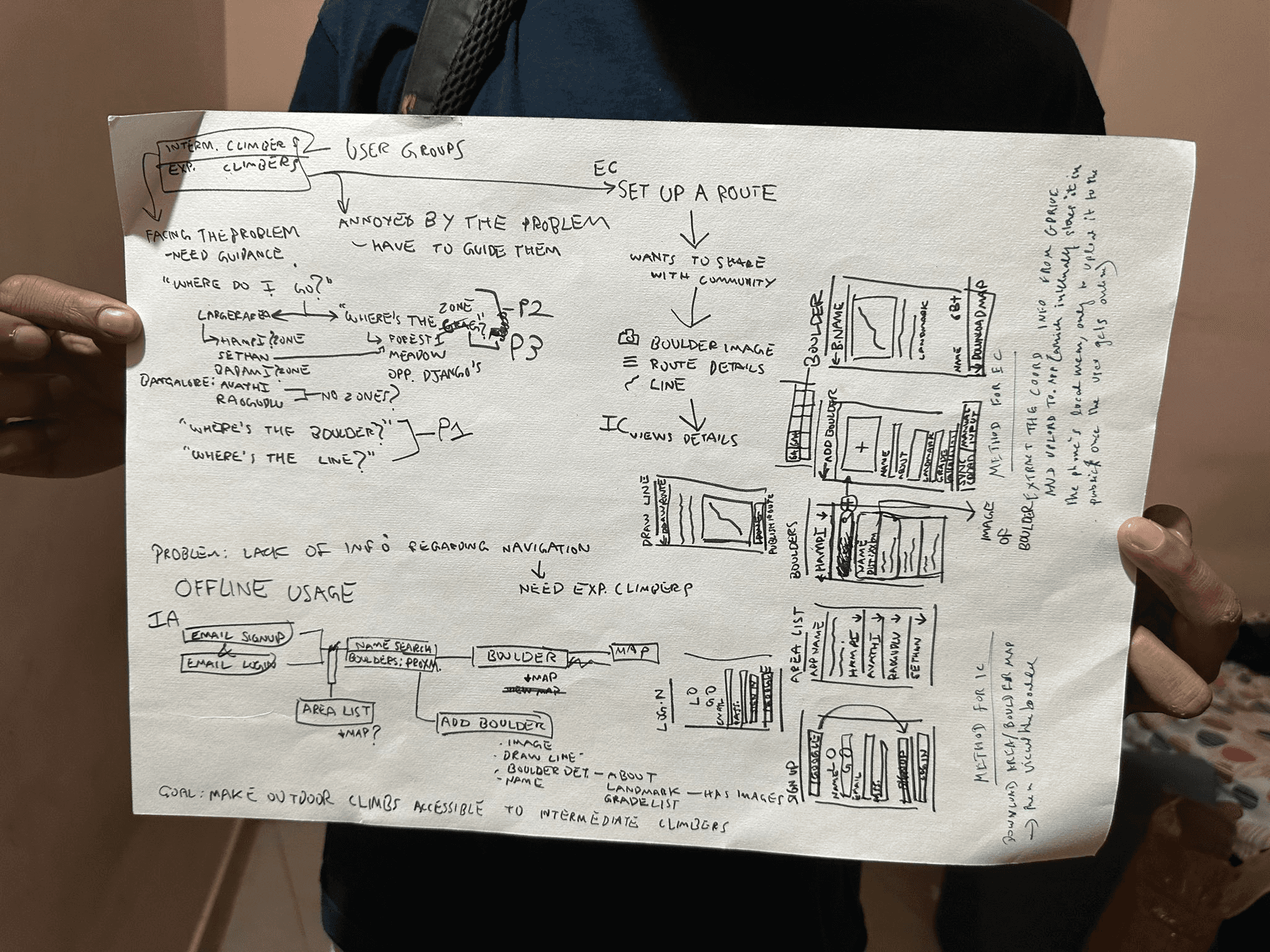
Low-Fidelity Wireframes - User Scenarios

To truly empathise with both user groups, we played out user scenarios to craft low-fidelity wireframes. Based on synthesised data and affinitised insights, I followed a lean approach to ideation, making sure to keep technical execution as quick and simple as possible. These wireframes were directly leveraged for development to speed up the process.

Scenario 1: Nikhil is looking for a new boulder to climb

Nikhil Thiyal

Novice Outdoor Boulderer

Nikhil is on his first outdoor climbing trip, he is getting tired of attempting hard boulders with the experienced climbers and wants to head out with his other novice friends. He aims to find a boulder that is suitable for his grade and fits his style. He hears about Boulderly from Arjun Mehta and downloads the app.

Scenario 2: Arjun has discovered a new boulder

Arjun Mehta

Expert Outdoor Boulderer

Arjun has spent the past few days figuring out how to climb a new boulder he discovered in Sethan, Himachal Pradesh. He cleaned the line and is ecstatic to have ascended it, now he wants to share the boulder with the community.

Mobile Application Development

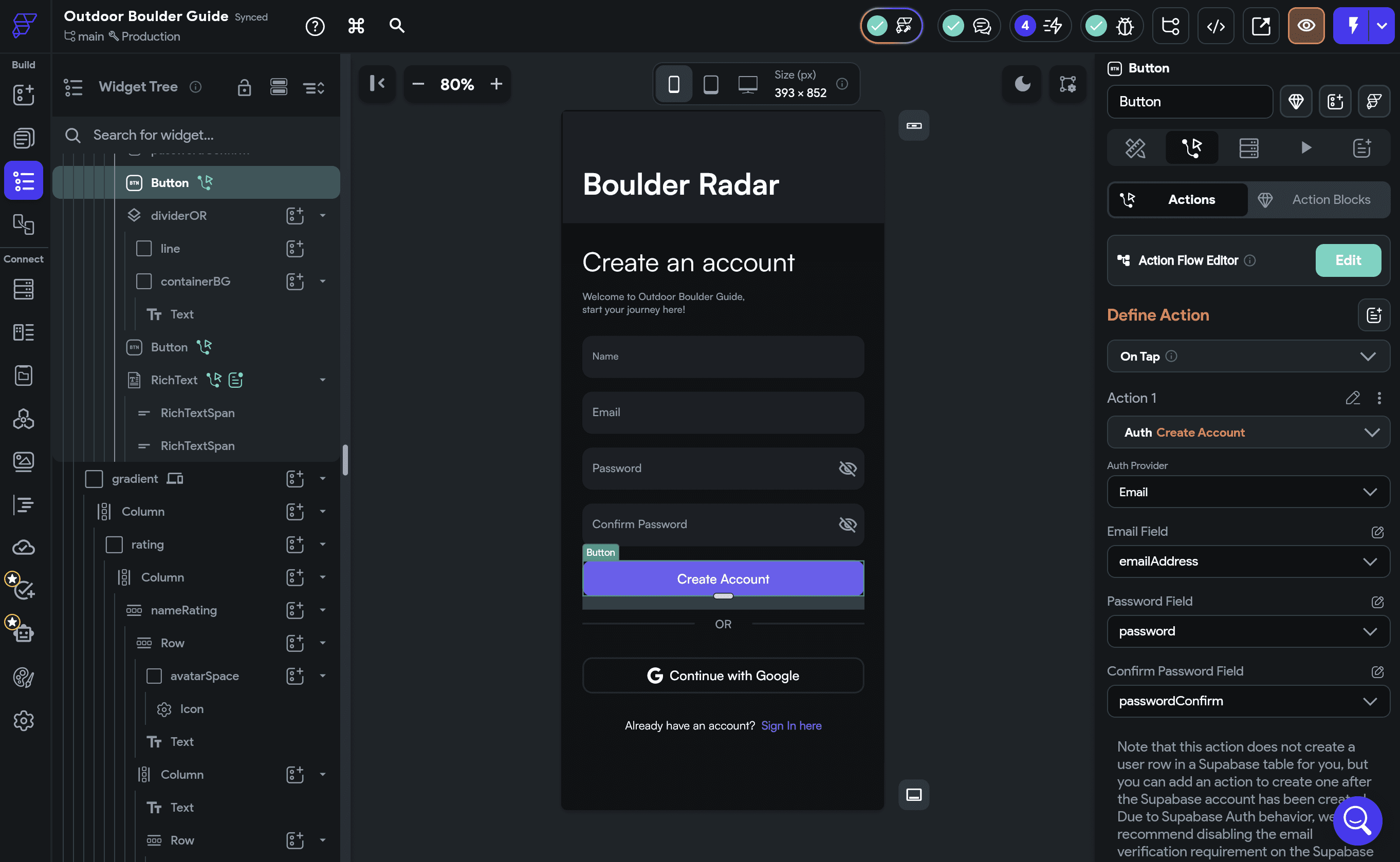
Having no prior experience developing a mobile application, we vibe-coded our way to an MVP leveraging Supabase for our back-end, Flutterflow for our front end and also integrated GoogleMaps and Mapbox to allow for offline navigation.

Front End Development

Leveraging Flutterflow, I vibe-coded the front end of the app and consulted with an expert developer to gain advice on solving more complex problems.

  • Implemented authentication flows using FlutterFlow’s auth layer, learning to handle session states, protected routes, and conditional UI rendering.

  • Refactored front end data models and screens to align with evolving backend requirements.

  • Implemented Google Maps API within Flutterflow to enable boulder locating in a familiar environment.

  • Optimised navigation and information hierarchy by restructuring screen flows and component reuse.

Back-End Development

This is where Rahul Peter comes in - he brings his hardware coding expertise to figure out the back-end code.

He also facilitated the integration of the front-end code with the back-end.

Boulderly - The MVP

Let's walk through the user scenarios and see how Arjun and Nikhil experience Boulderly.

The following images and videos are screenshots and recordings taken directly from the developed app.

Nikhil's Journey - The Novice Outdoor Boulderer

Let's see how the novice outdoor boulderer experiences Boulderly, through the lens of Nikhil Thiyal.

Signing Up

Nikhil Thiyal

Novice Outdoor Boulderer

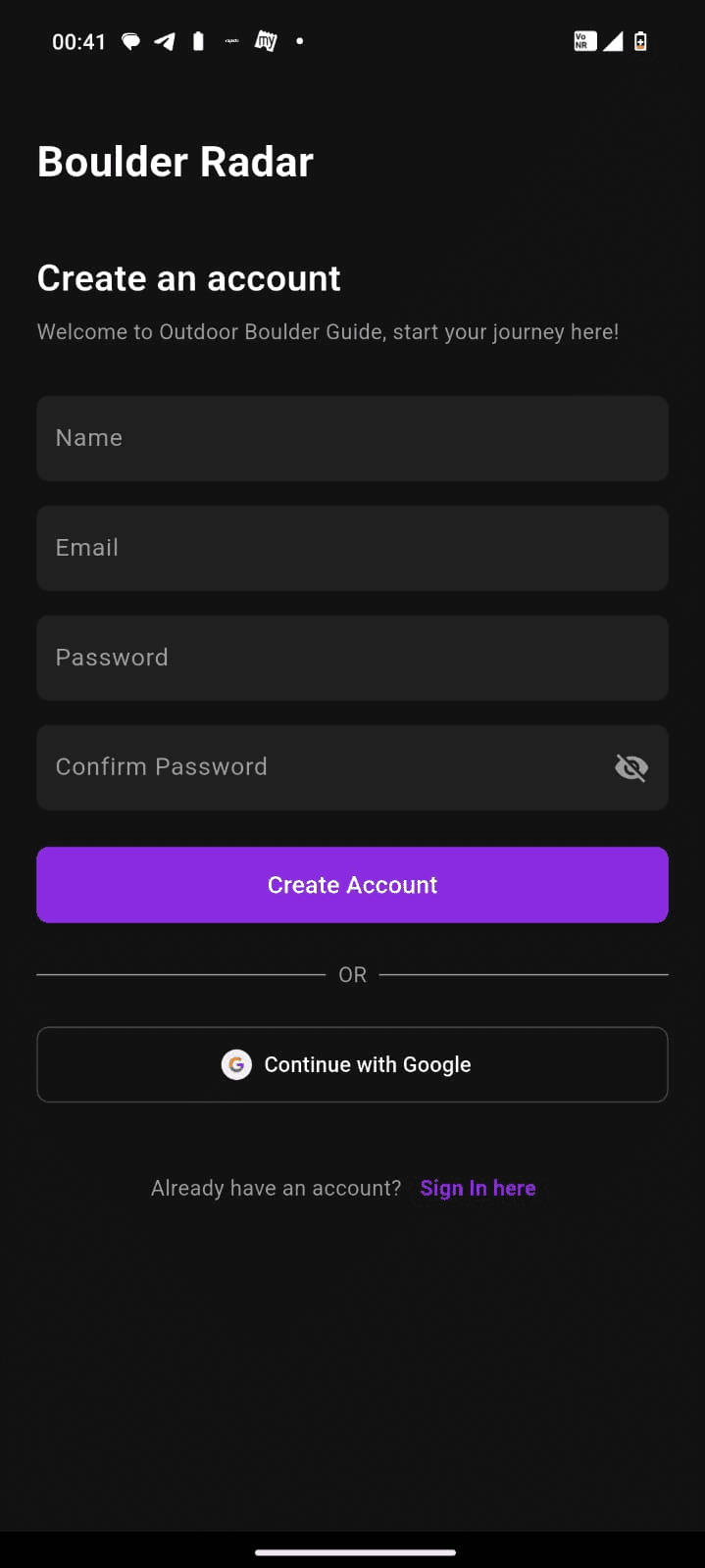
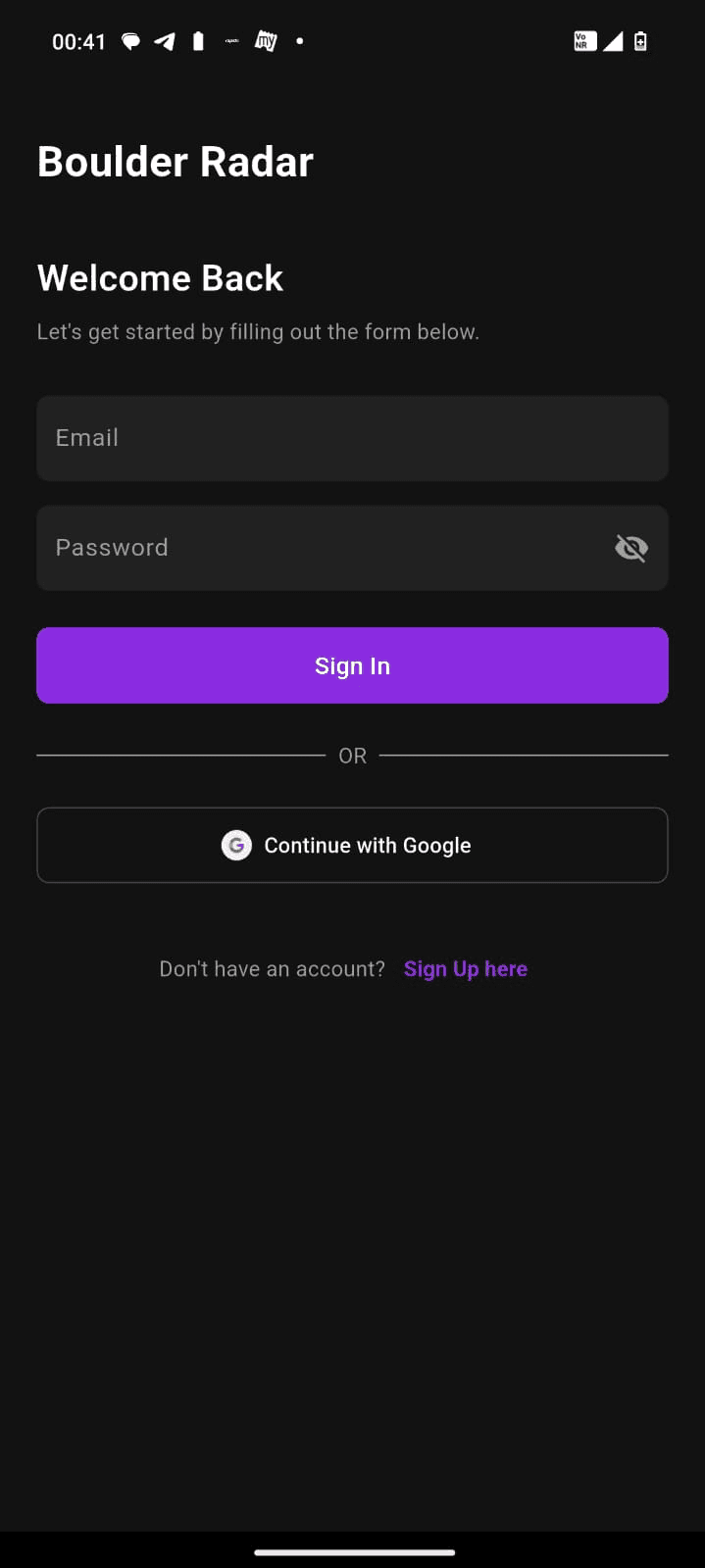
  • Arjun shares the download file with Nikhil, he downloads the app and installs the software.

  • Nikhil makes use of the Google Sign Up functionality to save time on entering his details, by default he remains logged in.

Zoning In

Nikhil Thiyal

Novice Outdoor Boulderer

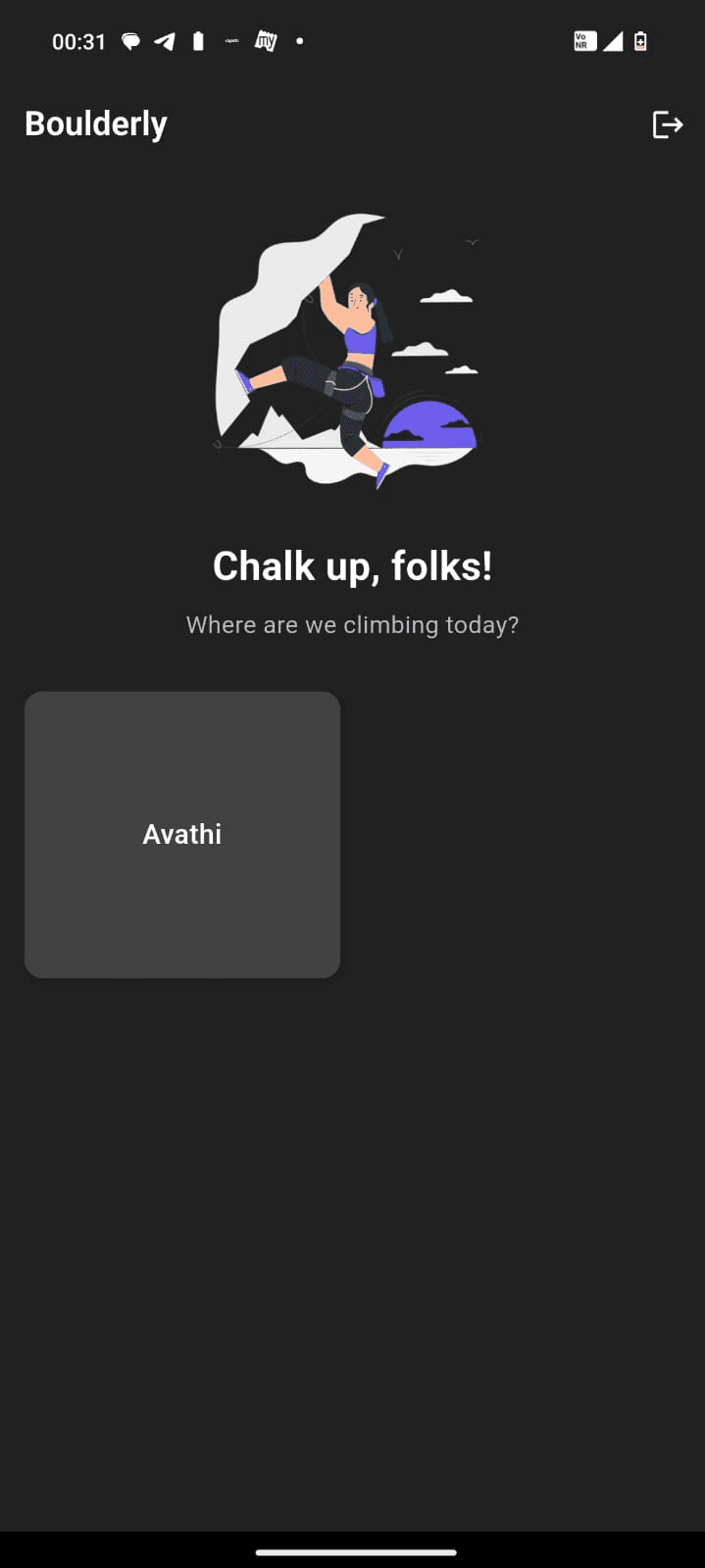
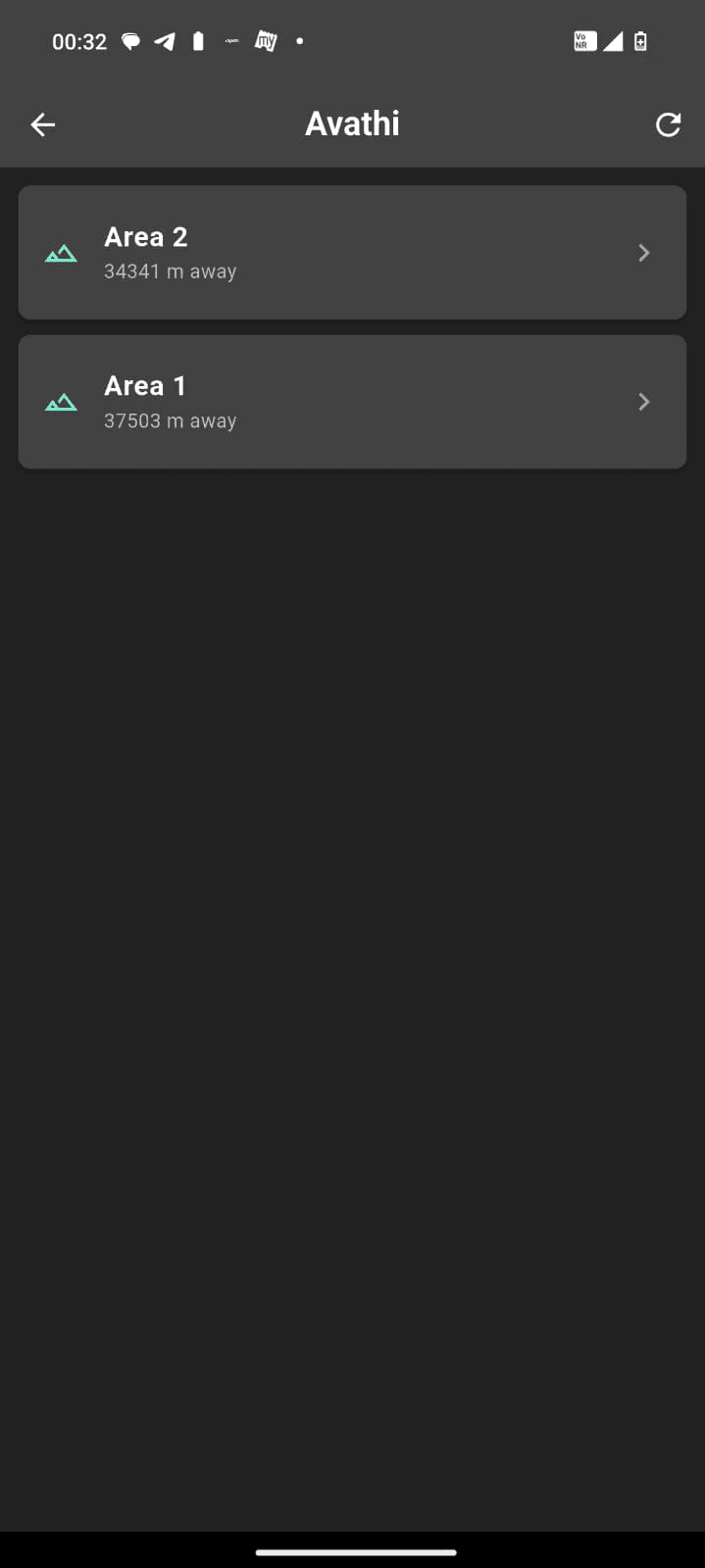
  • Nikhil picks the bouldering destination that he is at. The referenced image only shows 1 destination, Avathi, where we have been testing the app.

  • He continues to pick the specific crag within the destination from the list.

Searching & Sorting: Finding Boulders

Nikhil Thiyal

Novice Outdoor Boulderer

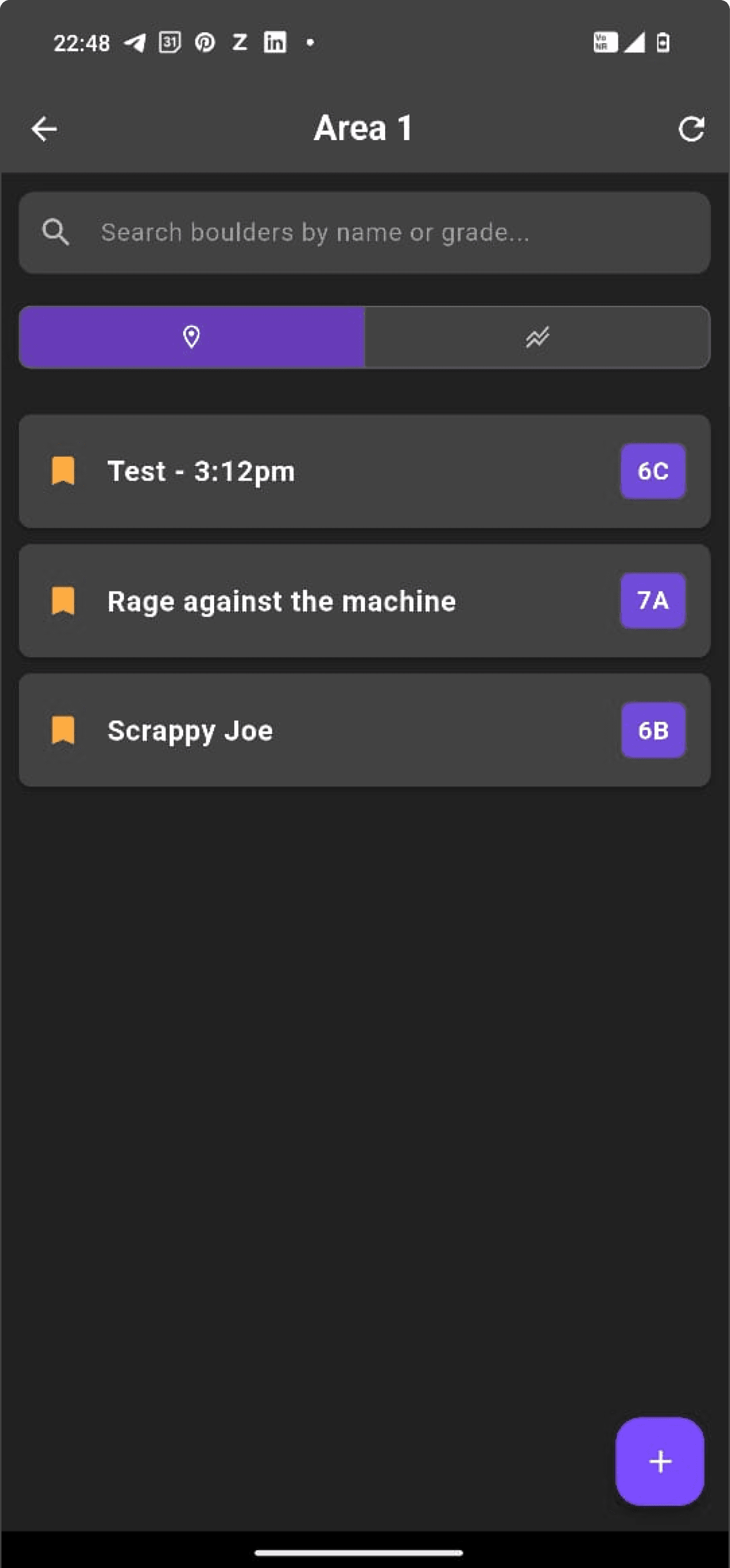
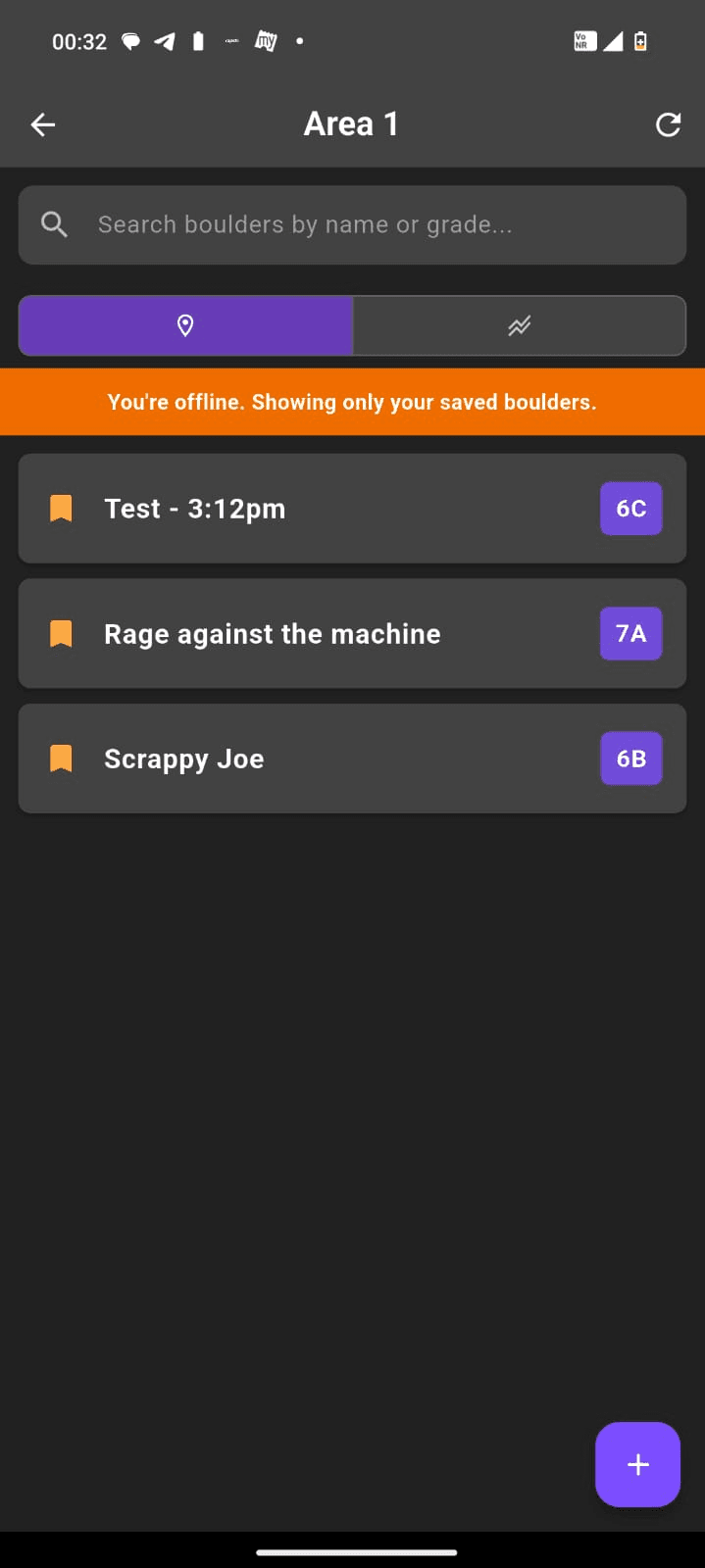
  • Nikhil is met with a list of boulders, he is delighted to see that he can search for a boulder from the outdated guidebook to find out it's location and further details.

  • He is happy to see that he can sort the boulders by distance or grade and that he can search by grade too, this makes the process of figuring out the plan much easier.

  • He finds a boulder that sounds interesting and taps on it to learn more.

Boulder Details: Saving selected boulders.

Nikhil Thiyal

Novice Outdoor Boulderer

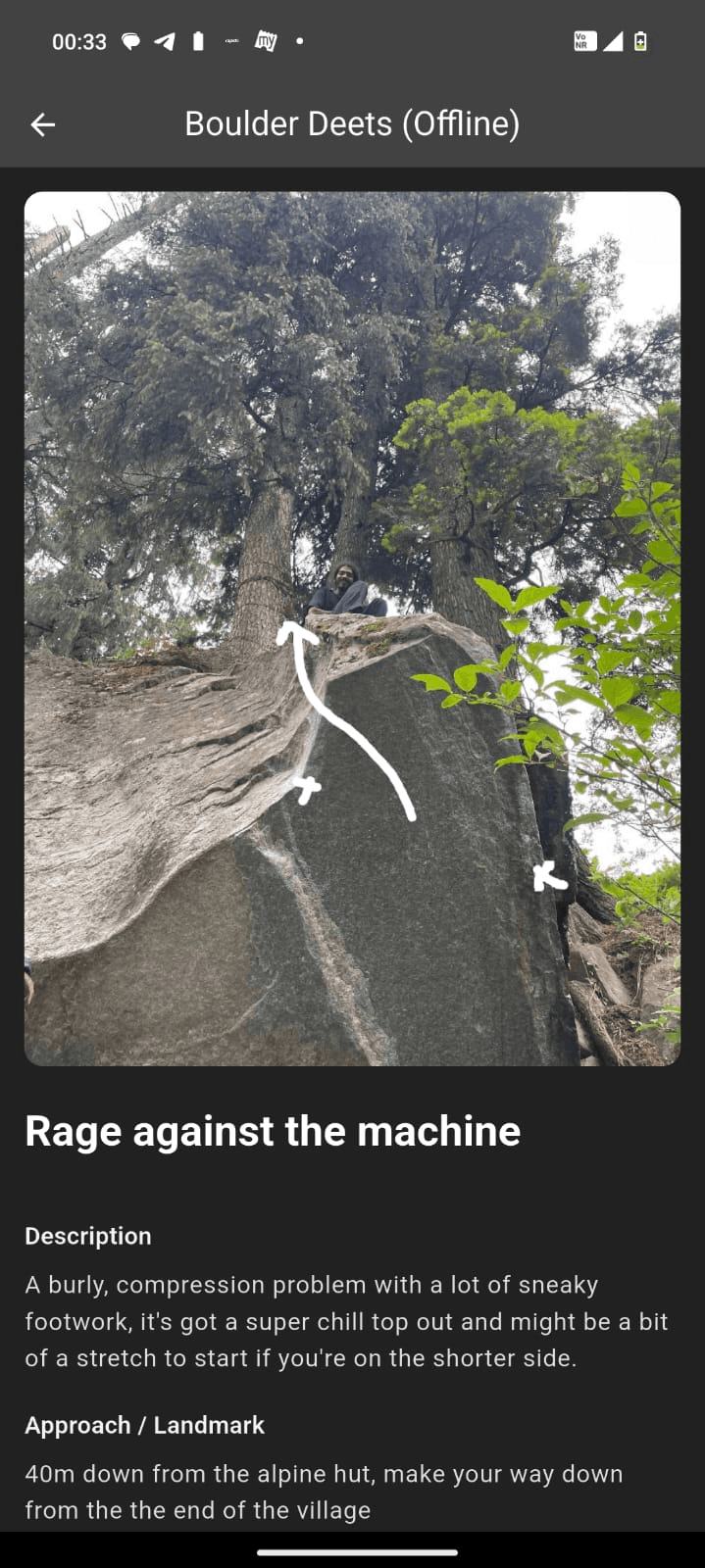
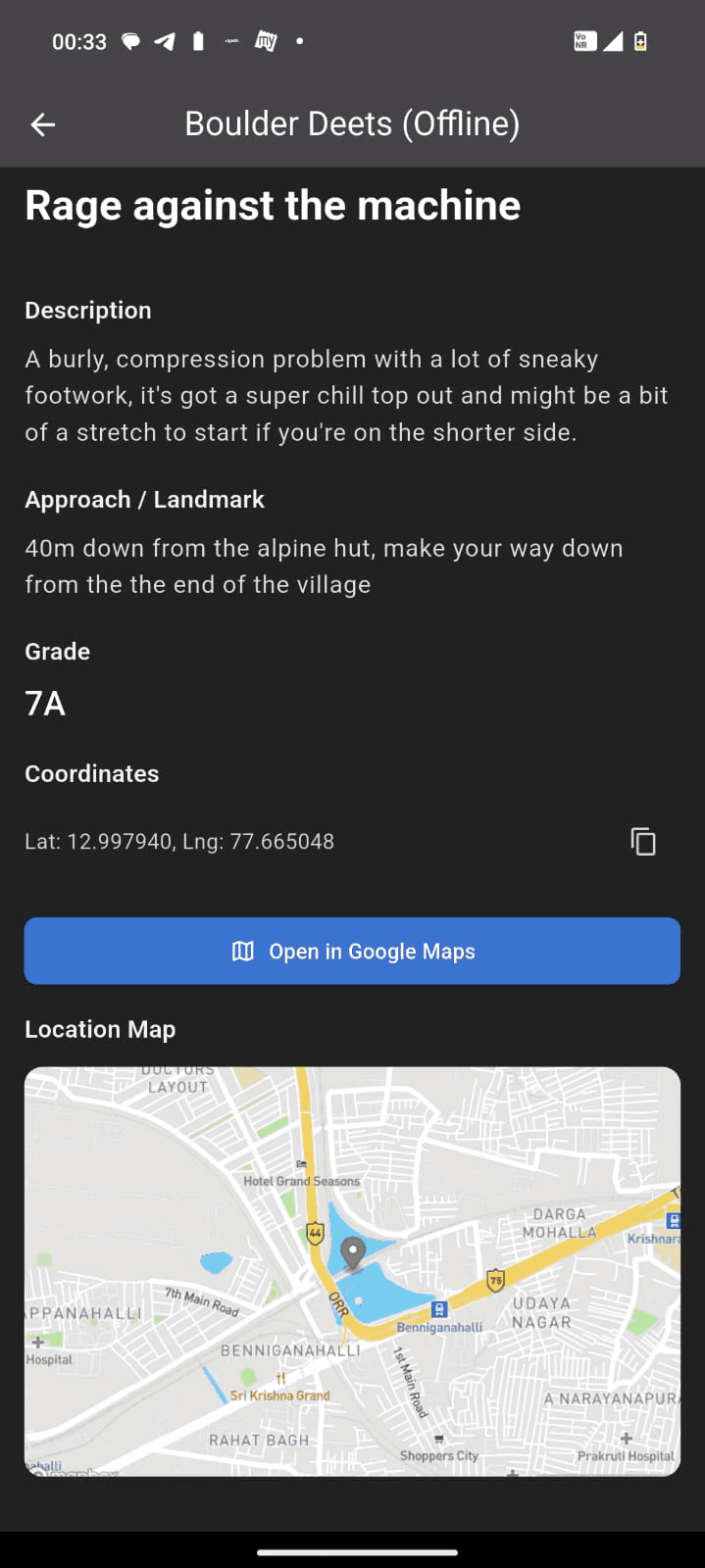
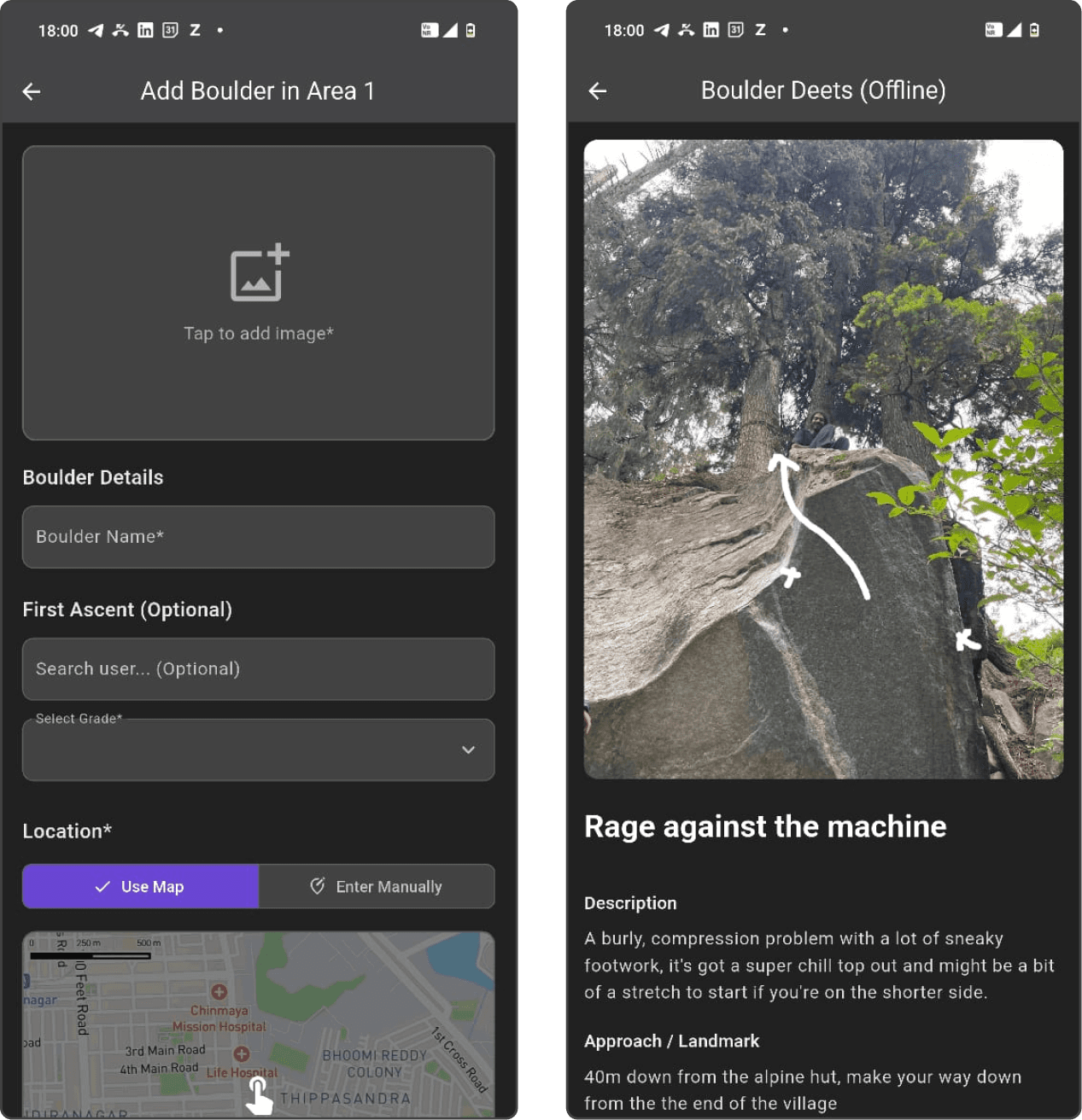
  • Nikhil checks out the image of the boulder, he begins to imagine the way he could climb it because the expert climber who added this boulder has drawn a line and starting points for it.

  • He reads the description to see if it's a problem that fits into his strengths/weaknesses.

  • He decides he wants to try it out tomorrow and saves the boulder details for offline usage the next day.

Offline Navigation: The day of the climb

Nikhil Thiyal

Novice Outdoor Boulderer

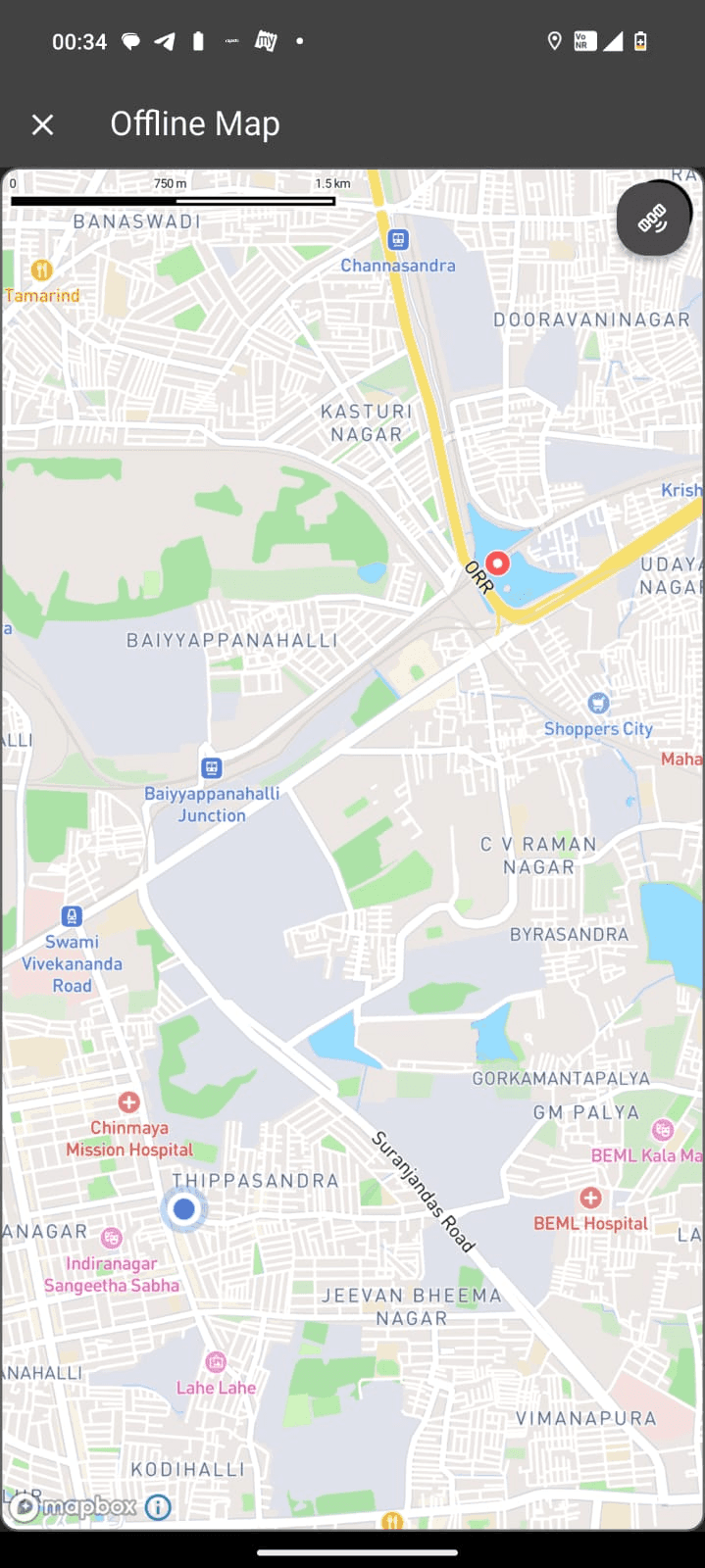
  • Nikhil has begun walking to the crag, he pulls out his phone and looks at the information of the boulders he saved.

  • He taps on the closest one and views the boulder details.

  • He taps on the map, he sees his own location in blue and the boulder location in a high-contrast red.

  • Once he enters the vicinity of the boulder, he has a look at the 'Approach/Landmark' as well as the boulder image which helps him find it quicker.

  • Nikhil finds the boulder, and is excited to get started!

Arjun's Journey - The Expert Outdoor Boulderer

Let's see how the expert outdoor boulderer experiences Boulderly, through the lens of Arjun Mehta.

Getting Started

Arjun Mehta

Expert Outdoor Boulderer

  • Arjun logs into the app right at the location of the boulder and navigates throught the app to the crag where he discovered his new boulder.

  • He taps on the '+' button, excited to share it with the community.

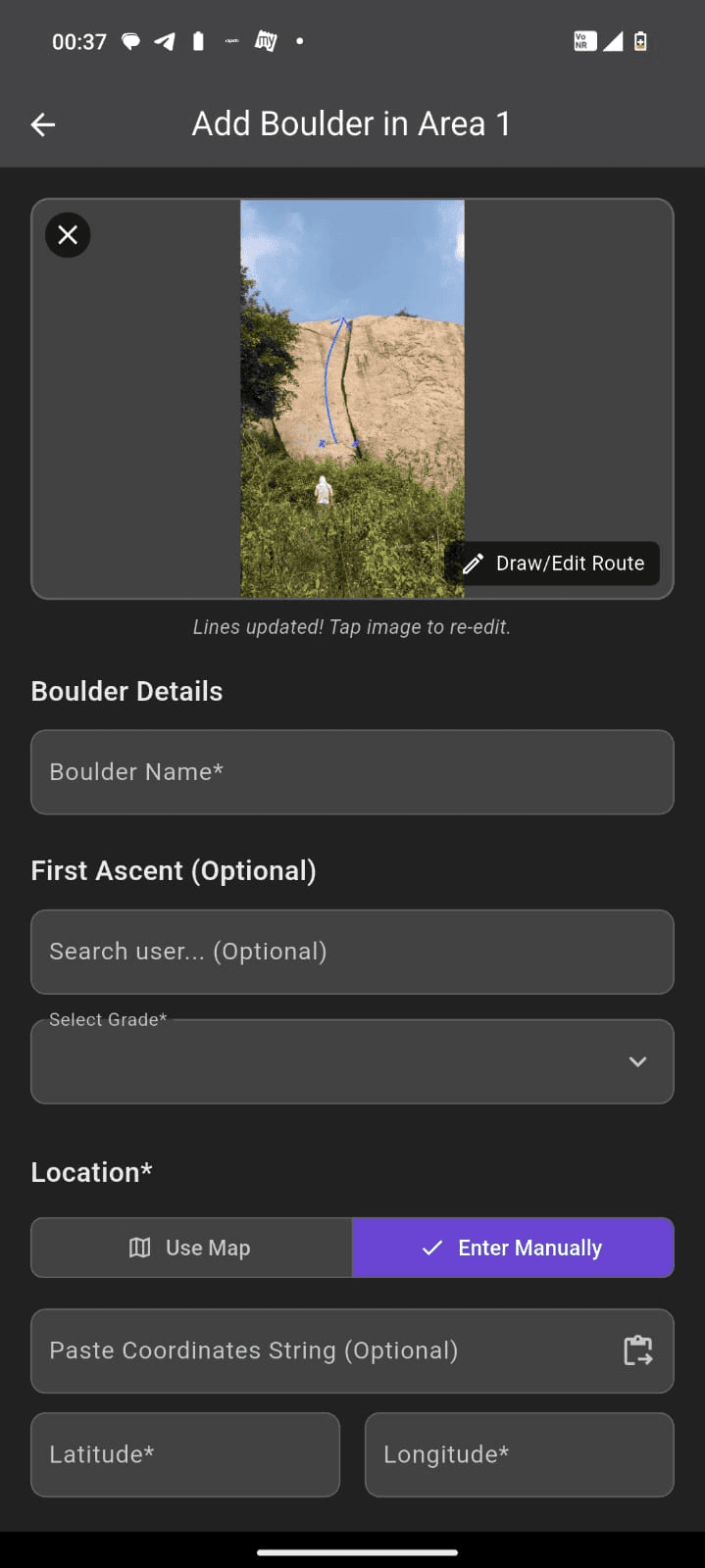
Adding The Boulder Image

Arjun Mehta

Expert Outdoor Boulderer

  • Arjun decides to take a picture of the boulder right then and there, he uploads it to Boulderly.

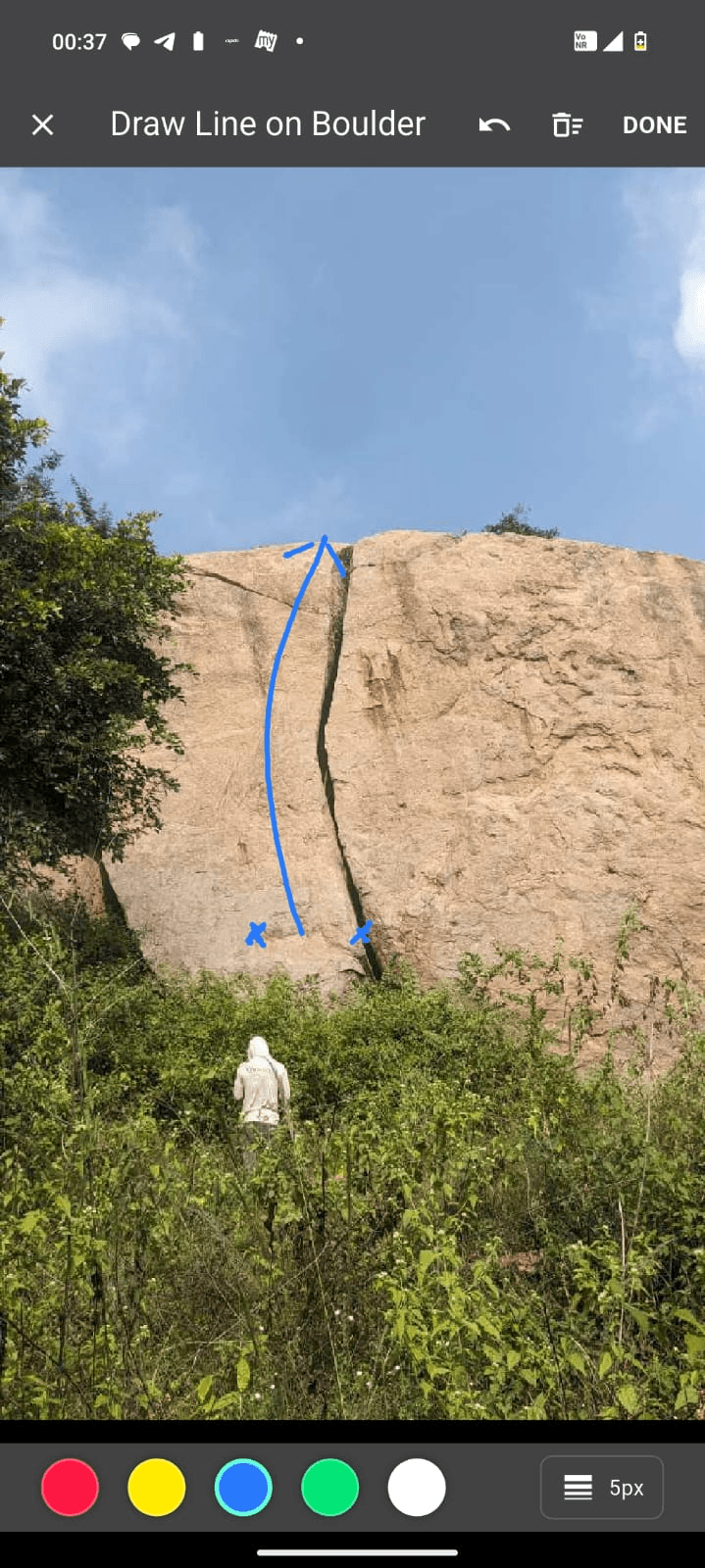
  • He then draws a line to guide the community about the route, he also decides to add some x marks to signify the starting holds.

  • He selects the blue colour and makes the line thick to create contrast with the boulder, he even makes use of the undo button to clean up the drawn line.

  • Finally, he taps done to complete image addition.

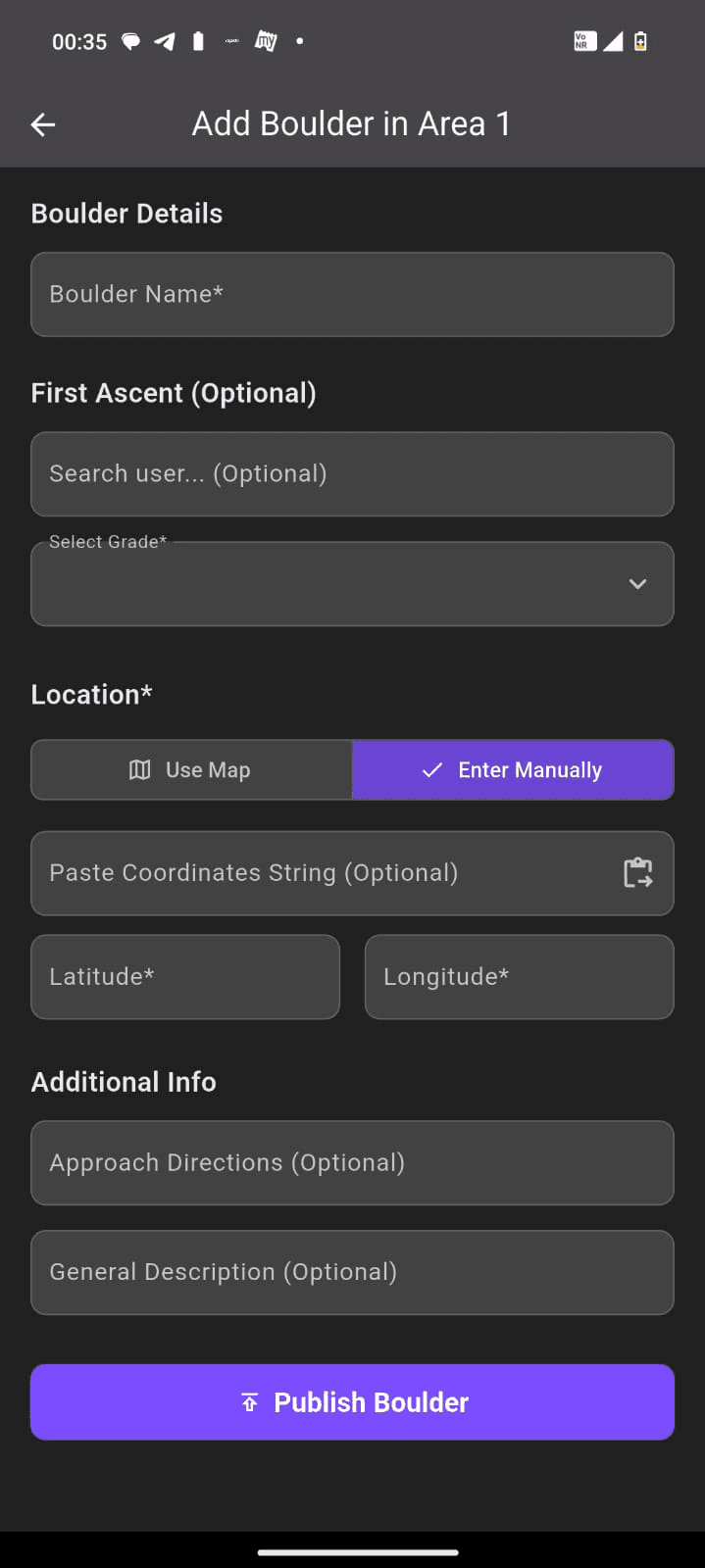
Adding Boulder Details

Arjun Mehta

Expert Outdoor Boulderer

  • Arjun then adds the details of the boulders to guide other users.

  • He comes up with and adds the name of the boulder, followed by the grade that he suggested.

  • Since he is at the location of the boulder, he uses the map to pinpoint the location.

  • He is delighted to see the 'Enter Manually' feature signifying that he can add boulder details back at home base too.

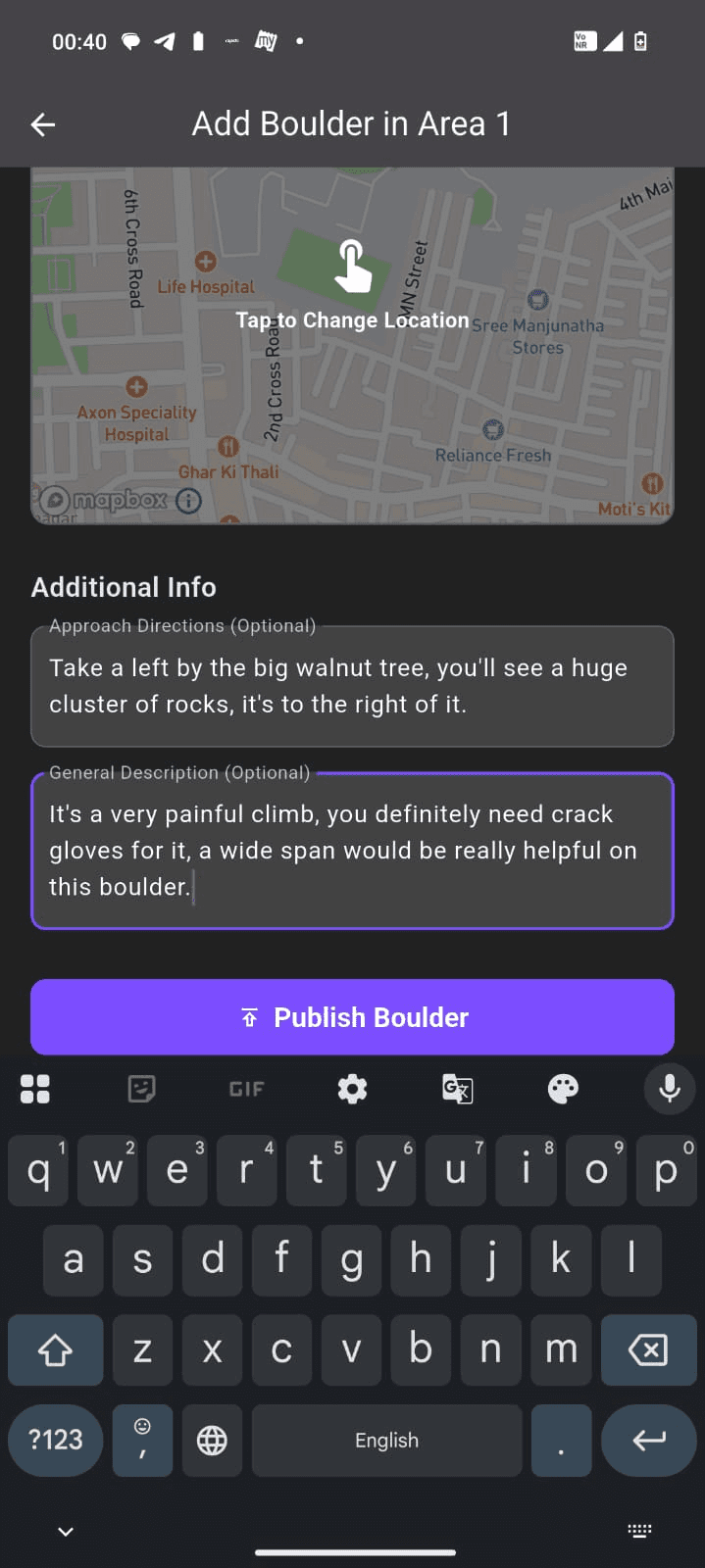
Publishing The Boulder

Arjun Mehta

Expert Outdoor Boulderer

  • Arjun then adds auxilliary details to convey what kind of boulder it is, and how to approach it.

  • Arjun publishes the boulder, he is notified that the details are saved and will be uploaded when network is available.

  • He is happy to have shared his new discovery with the community and is excited to see what people think of it.

Usability Study

We conducted a usability study in Avathi, a bouldering destination on the outskirts of Bangalore, India.

'Expert' Study

I conducted a field study where I tagged along to boulder with 2 individuals who were responsible for discovering and developing Avathi. These expert users were observed adding the details of a few boulders to the platform.

'Novice' Study

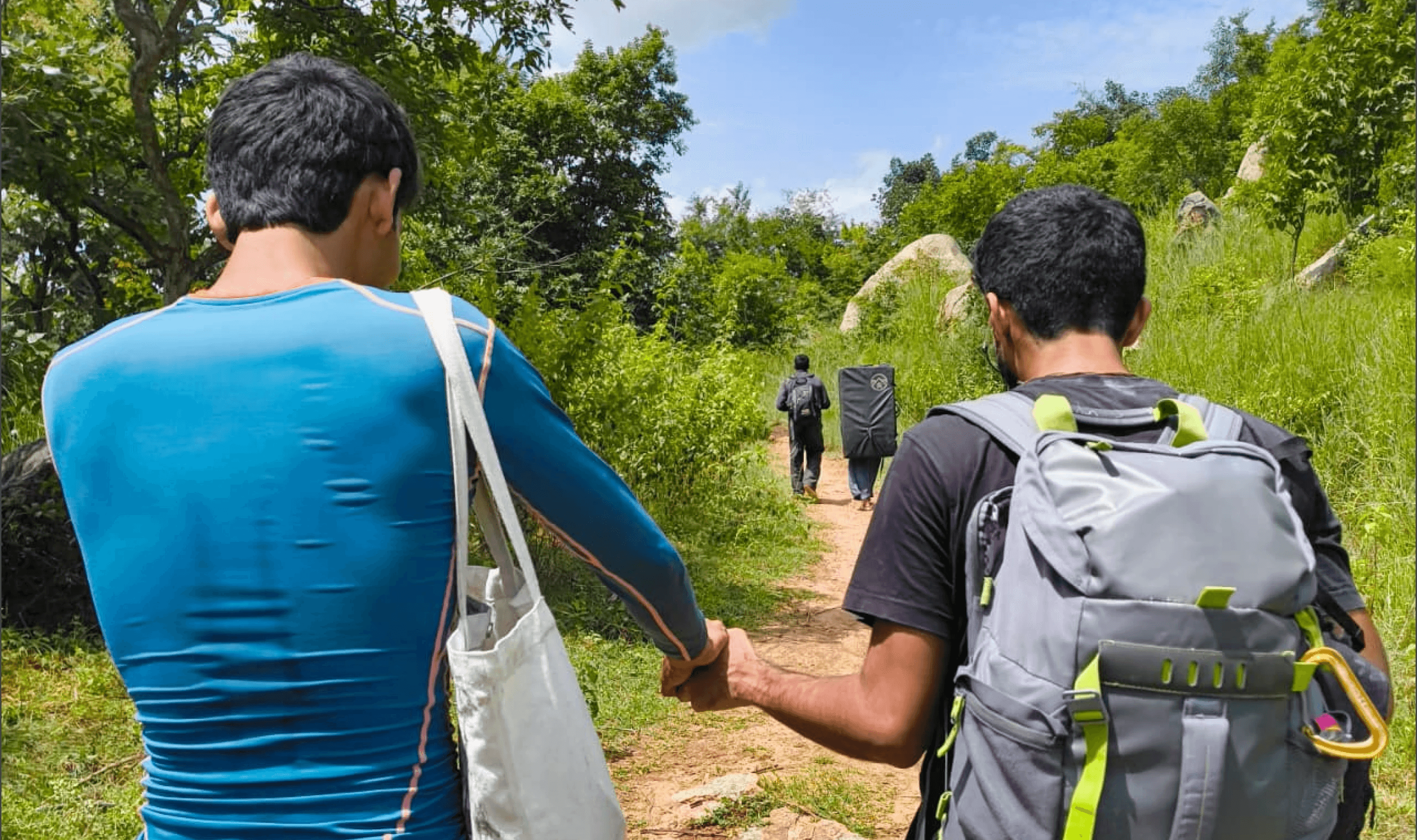
I joined a group of 5 novice outdoor climbers, 4 of which had never been to the destination before and 1 of which had been to the destination once prior. They were provided with the app and instructed to navigate to the boulder without any other information.

Objectives

  • To identify whether the core funtionality satisfies the overarching problem.

  • To identify any bugs and flow failure points that make the process complicated.

  • To identify features that will improve the app experience for future phases.

  • To see how the product works in tandem with real-life user journeys.

  • To gain subjective impressions of the users.

Actionable Insights

  • Expert climbers were delighted as they could add the details from the location itself, instead of having to save information manually and add it later.

  • They believed that certain integral features such as communal grading and marking First Ascents (the 1st person to climb the boulder) were missing.

  • Novice users wanted the ability to save all boulders at once.

  • Expert users felt that the app lacked the community spirit rooted in the practice of bouldering.

  • Novice users felt a sense of confidence finding these boulders themselves, they believe that this software will result in more outdoor trips.

  • Expert users believed this was an immediate necessity not only for Sethan, but for Avathi and were happy to provide their own boulder data.

MVP Iterations

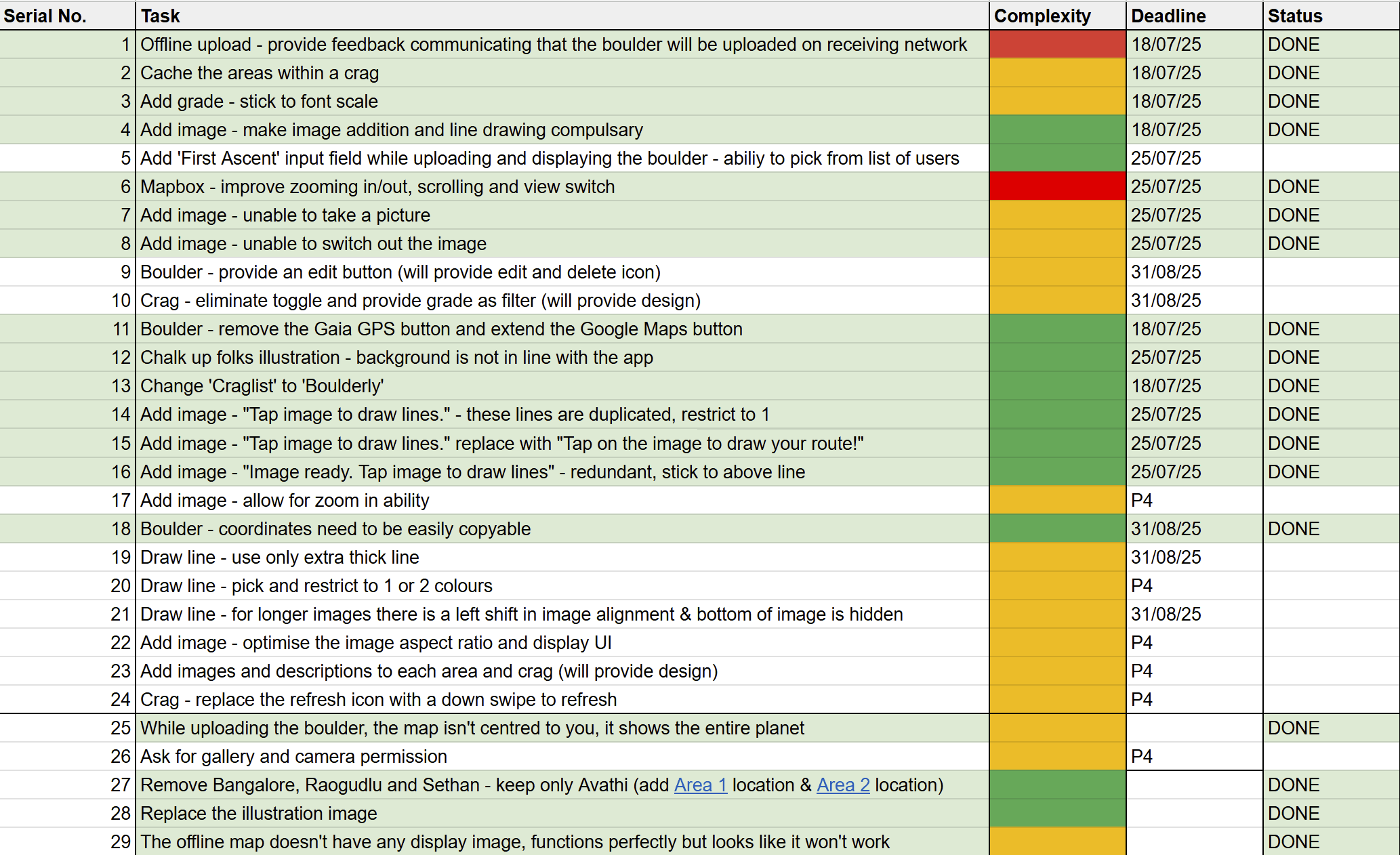
Bug fixes and high-impact, low-effort features were identified for quick iteration.

What's Next?

Database Format → Community Format

While the MVP solves the core problem, a major concern was the disconnect from the social aspect of bouldering. The MVP feels like a database for bouldering data, when it should feel like a community-oriented application that is people first and boulders second. We are currently in the ideation process to make this shift.

Field Study in Sethan, Himachal Pradesh

Through the preliminary research, I built relationships with individuals instrumental in the discovery and development of Sethan. We are excited to test out our MVP in the summer season, when boulderers from all over India and beyond make their trip here. The plan is to add all the boulders within a particular crag and test it out with the boulderers who are both familiar and unfamiliar with the area.

Features for the Next Phase

  • 3D Imagery: Providing the ability to scan and upload a 3D image of the boulder to aid identification.

  • Ascent Tracking: Ability for users to document their ascent and share it with the community.

  • Communal Grading: Ability for users who have climbed the boulder to suggest a grade, the mode of this grade will decide the final, represented grade.

  • Boulder Destination details: Story & history, wildlife to spot or be concerned about, safety instructions, environmental concerns to comply with.

  • Boulder Story: It is very important for expert boulderers to share the story of the boudler and the name so that it lives on.

  • Crag Feed: Replacing the straightforward list with a social app structure, prioritising boulderer details and imagery to showcase newly opened boulders, popular boulders, lost treasures and so on.

Me climbing a boulder in Sethan (Image Credit: Monodit Climbing)

Future Work

  • Updating the application from the MVP version to the community-oriented version.

  • Improving the identification of the boulder via 3D mapping, rather than just imagery.

  • Field study in Sethan village to refine built-out features.

  • Market study to identify translatable bouldering areas, within and outside of India.

  • Further local field testing in Avathi, India as we build out the community-oriented version.

Have a look at my other projects

Smart TV - Typing

  • Academic Research Project

  • HCI Researcher

Admin Console Chatbot

  • UX Design

  • Interaction Design Intern

Alphaherd

  • Entrepreneurial Project

  • Co-founder

Canine First Aid Kit

  • Tangible Design

  • Product Designer

Hi, I'm Pranav Ashwin Ramesh

I’m a curious, self-motivated and passionate user experience designer and entrepreneur. Here’s some of my best work grounded in my experience navigating academic research, real-world industry challenges, and entrepreneurial ventures.

Interested in working together?

Shoot me an email if you'd like to chat.